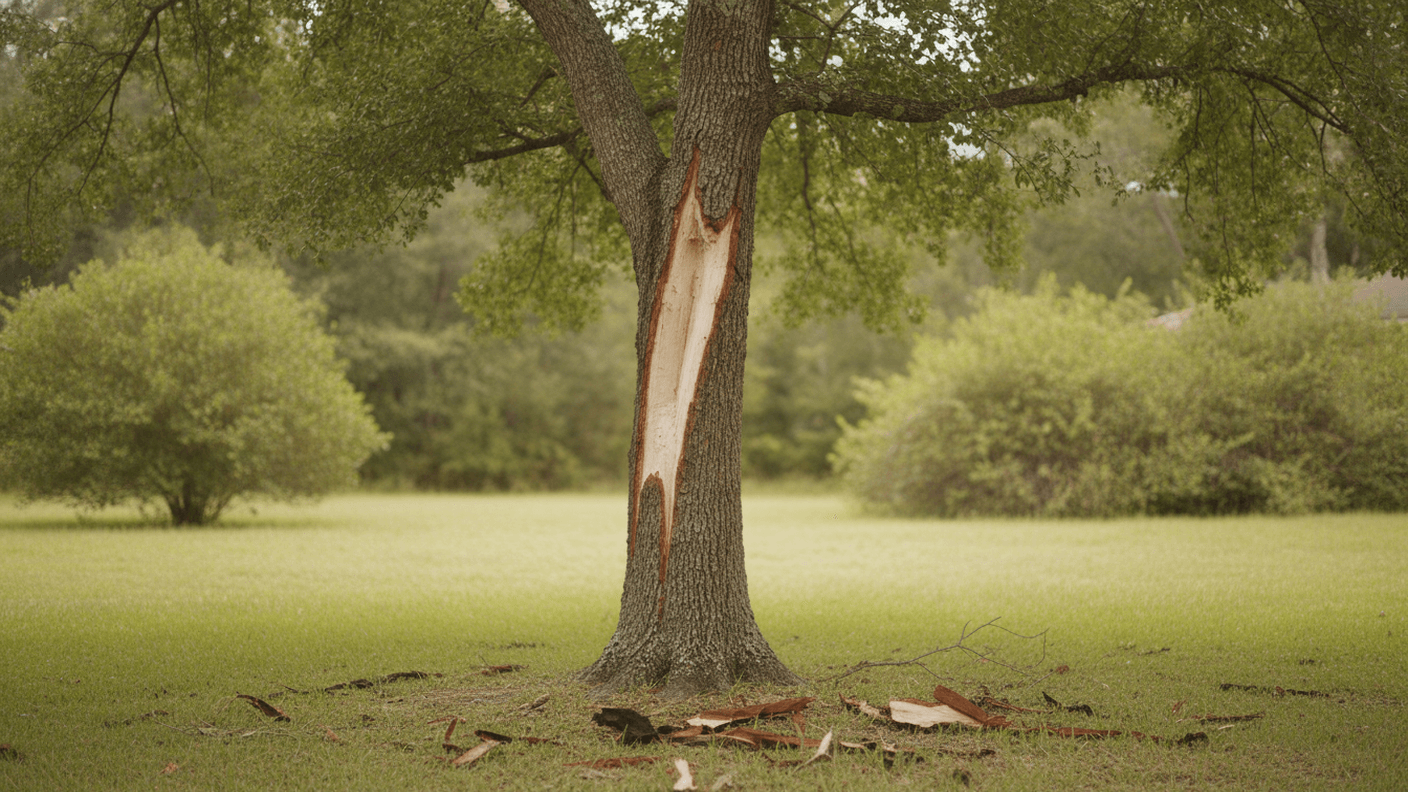
Here’s how to tell if a tree was struck by lightning: look for a vertical gash of blown-out bark down the trunk, a palm crown that collapsed within days of a storm, or leaves that wilt and brown a few days after the weather cleared. What you do next depends on what kind of tree it is, and the two answers are opposites.
A direct strike is usually fatal to a palm, and a badly damaged one can come out while the fronds are still green. A struck broadleaf tree gets several weeks of watching first, because the damage inside takes that long to show up in the crown.
How can you tell if a tree was struck by lightning?
A vertical trunk gash is among the clearest visible signs. Lightning can also leave several scars along the same side. The living tissue between those scars may already be dead.
A strike doesn’t always leave an obvious trunk scar, though. Alabama Cooperative Extension says internal damage can remain invisible at first. Leaves can wilt and brown several days later with nothing on the trunk to explain it.
Look around the entire tree and nearby planting area for:
- A longitudinal gash running down the trunk
- Multiple scars clustered along one side
- Fresh areas of missing bark
- Small shot-like holes in the trunk
- Sap bleeding from damaged trunk tissue
- Sudden wilting or browning after a thunderstorm
- Damage or death among nearby understory plants
- Loose soil around the base of a palm
One symptom on its own doesn’t confirm a strike. Disease and storm damage look a lot like it. An arborist consultation can assess the tree’s structure, crown, and surrounding targets.
Timing helps you read the evidence. Palm symptoms usually start within days of the thunderstorm. Broadleaf damage takes several weeks to declare itself.
What does lightning actually do inside a tree?
Lightning follows the water inside a tree and generates intense heat. The US Forest Service describes this process as cooking the tree internally.
That heat damages trunk, root and crown tissue. Some of it shows the same day, and some of it doesn’t show at all. A tree can look untouched right up until its leaves wilt.
The US Forest Service says about half of struck trees die instantly. That’s a population figure, not a prediction about your tree. Alabama Cooperative Extension is blunt about it: there are no fixed guidelines for predicting whether a struck tree survives.
One strike can take out more than one tree. That matters most where palms stand close together. The directly struck palm may die quickly, while nearby palms linger for months.
So check the neighbors too. It’s not unusual to find several struck trees in one small area.
What are the signs in a palm, and how fast do they show up?
Lightning-damaged palms often show symptoms within days of a thunderstorm. UF/IFAS Extension says the crown usually collapses from the older, lower fronds first.
Those fronds stay green at first. They turn brown within days, or in two to three weeks. Mature and immature nuts may also fall shortly afterward.
Other documented palm symptoms include trunk bleeding and longitudinal gashes. Small shot holes can appear across the trunk. The upper trunk may become hollow and contain odorless slush.
Height is the risk factor, especially for a palm standing in the open. UF/IFAS identifies royal, coconut, and Washington palms as particularly vulnerable. Other tall palms can be just as exposed.
The symptoms mimic several palm health problems, which is where people go wrong. UF/IFAS specifically names lethal yellowing disease, trunk rot, palmetto weevils, and storm damage. Our guide to lethal bronzing in Florida palms covers another serious palm disease.
A direct lightning strike on a palm is usually fatal. UF/IFAS says these injuries can’t be treated. A palm with collapsed fronds or a broken crownshaft can be removed while green.
That puts a struck palm on the palm tree service path rather than the wait-and-watch path. It’s the difference between dealing with it now and waiting out a month that can’t change the outcome.
UF/IFAS also says to take out the dead trunk and the stump. A dead palm is a magnet for Ganoderma butt rot. Grinding the palm stump removes that food source.
Can a tree survive a lightning strike?
Plenty of broadleaf trees do survive, but nobody can tell you in advance which ones. Alabama Cooperative Extension says to wait several weeks before pruning or removing one. That period allows hidden crown damage to become visible.
That waiting rule is for broadleaf trees, live oaks included. It doesn’t cover a palm with collapsed fronds or a broken crownshaft. UF/IFAS allows those visibly damaged palms to be removed while still green.
A broadleaf tree with shallow scars can stay under observation. That’s scarring covering less than one-third of the trunk diameter. Preventative treatments are worth discussing once someone has looked at it.
Water it while you wait. Alabama Cooperative Extension says to keep the top six to nine inches of soil moist, once or twice a week.
Heavier structural damage changes the answer. A split trunk or major crown loss points to removal. So does location, once damaged wood is standing over a house or a driveway.
Review the signs that a tree is hazardous while watching a broadleaf tree. That checklist helps separate visible structural problems from gradual canopy decline.
When should a struck tree come out?
A split tree should be removed, according to Alabama Cooperative Extension. Its one-third rule provides additional visual thresholds for broadleaf trees.
- Remove a tree that has totally or partially split.
- Consider removal when over one-third of its canopy is blasted away.
- Significant scars covering one-third of the diameter support removal.
- Bare trunk scars over one-third suggest substantial future decay.
- Scars under one-third make the tree a better observation candidate.
- Count tissue between same-side scars as damaged tissue.
None of that predicts survival. It organizes what you can actually see into something an arborist can work from.
Location can outweigh the size of the scar. Alabama Cooperative Extension recommends removing damaged trees near homes, streets, driveways, or frequently used areas. What the tree would land on carries as much weight as how it looks.
Use the tree removal service when an assessment supports removal. For a split tree threatening a home, request emergency tree service.
If the tree has already fallen, follow the steps in our storm-damaged tree guide. That situation requires a different response from monitoring a standing tree.
What should you do during the first week after a strike?
Start by naming what you’re looking at, a palm or a broadleaf tree. Everything after that depends on the answer.
For a broadleaf tree, don’t reach for the saw unless the removal thresholds are already met. Alabama Cooperative Extension advises waiting several weeks for hidden damage to appear. Watch the crown for sudden wilting, browning, or canopy loss.
For a palm, look at the crownshaft and where the fronds are sitting. A collapsed crown or broken crownshaft supports removal while leaves remain green. Don’t hold that palm to the broadleaf waiting rule.
Walk the rest of the yard while you’re at it, including the understory plants. One strike can damage multiple trees in a small area. Indirectly affected palms may continue declining for months.
An arborist measures the scars against trunk diameter and counts what’s missing from the canopy. They’ll also look at what’s underneath it: the house, the driveway, the street, the spot where everyone parks.
Tampa Tree Pro connects homeowners with ISA-certified arborists in its network. Contact us to request an assessment after suspected lightning damage.
Why does this happen so often in Tampa Bay?
Tampa averages 82.7 thunderstorm days per year, according to UF/IFAS. That places Tampa second nationally behind Fort Myers at 88.0 days.
UF/IFAS also calls Florida the lightning capital of the world. AccuWeather figures cited by UF/IFAS estimate 3,500 cloud-to-ground strikes daily statewide. The same cited figures estimate 1.2 million strikes annually.
These are statewide historical averages, not Tampa strike counts. Tampa’s 82.7 figure measures average thunderstorm days each year.
Tall palms along an open street are exposed. So is a live oak standing alone on a lawn. The tallest trees, and single specimens out in the open, have the greatest potential for strikes.
That’s true in Seminole Heights, Carrollwood, Brandon and Town ‘n Country, and it’s true across St. Petersburg and Clearwater.
Our Tampa tree service page covers the local service area. The Tampa storm preparation guide explains how to address existing tree defects before severe weather.
Do lightning protection systems work?
A lightning protection system gives the strike a preferred path to ground. It doesn’t drain the charge away, and UF/IFAS is explicit about that.
It has to be installed by an experienced certified arborist, and it can last up to 50 years if it’s maintained. Younger, faster-growing palms should receive annual inspections.
Older, slower-growing palms need inspections every two to three years. A growing canopy can hide the conductor, which is what those inspections are checking for.
UF/IFAS says most homeowners probably can’t afford the cost and the upkeep. It makes more sense on a small number of high-value trees. An arborist can tell you whether yours is one of them.
Frequently asked questions
What is the clearest sign of a lightning-struck tree?
A vertical gash down the trunk is a strong visible sign. Multiple same-side scars, missing bark, and sudden canopy decline also matter. Some strikes leave nothing on the trunk at all.
How quickly does lightning damage appear?
Palm symptoms can begin within days of a recent thunderstorm. Their green fronds may collapse before browning within days or weeks. Broadleaf damage can take several weeks to appear throughout the crown.
Can a lightning-struck tree survive?
Some broadleaf trees survive, but no fixed prediction guidelines exist. The US Forest Service says about half of struck trees die instantly. A palm directly struck by lightning is usually fatally damaged.
Should you prune a tree immediately after lightning?
Wait several weeks before pruning a struck broadleaf tree. That allows hidden crown damage to become visible. This advice doesn’t apply to a palm with collapsed fronds or a broken crownshaft.
Can a lightning-damaged palm still look green?
Yes. A badly damaged palm can hold green fronds for a while. UF/IFAS says collapsed fronds may brown within days or several weeks. A collapsed crown can support removal before those leaves turn brown.
Can one lightning strike damage several trees?
Yes. One strike can damage several trees or palms standing close together. A directly struck palm may die quickly. Indirectly affected palms can decline slowly for several months.
What if the tree has several scars?
Count the tissue between same-side scars as damaged tissue. Alabama Cooperative Extension says that tissue is likely dead. An arborist can compare the combined damage against the one-third threshold.
Who should assess a suspected lightning strike?
An arborist, who’ll check the trunk, the crown, the roots and what’s standing underneath. Palms and broadleaf trees need different calls. Request an assessment through our contact page when lightning damage is suspected.