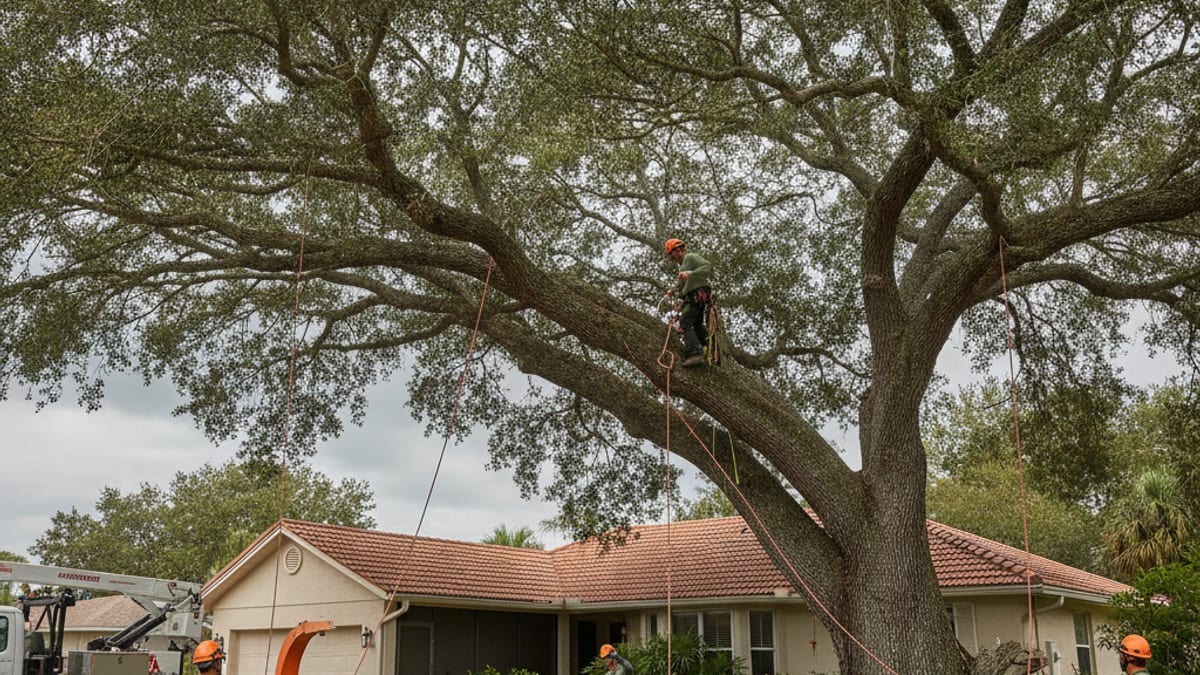
Most trees that fail during a Tampa Bay storm gave warning signs for months, sometimes years, before they came down. The problem is that a lot of those signs look like normal tree behavior unless you know what you’re looking at. A slight lean, a few dead branches near the top, some mushroom-looking growth at the base, none of it seems urgent on its own. Together, they’re often the clearest picture a tree can give you that it’s failing structurally.
Here’s what to actually watch for on the trees around your house, before hurricane season decides for you.
A lean that’s new, not old
Plenty of mature trees in Tampa Bay have a natural lean, especially oaks that grew reaching for light around other trees or structures. That’s not automatically a problem. What matters is whether the lean is new or has gotten more pronounced recently, and whether you can see soil lifting or cracking on the side opposite the lean, which usually means the root system is starting to fail and the tree is tipping rather than just growing at an angle.
A tree that’s leaning more than it used to, especially after heavy rain when the ground is saturated, is one of the more urgent signs on this list. Saturated Florida sand and clay soils lose their grip on root systems fast, and a tree that shifts noticeably during or after a storm may already be past the point where bracing or cabling helps.
Cracks, splits, or included bark in the trunk
Look at where major limbs meet the trunk. A tight, V-shaped union where two large limbs grow close together, sometimes with bark pinched between them rather than a smooth, rounded connection, is called included bark, and it’s structurally weaker than a wide U-shaped union. These joints are prone to splitting under wind load or the weight of a heavy limb, and they often fail catastrophically rather than gradually.
Vertical cracks running down the trunk, especially ones that open and close slightly when the tree sways in wind, indicate the wood fibers underneath are already separating. This isn’t cosmetic bark damage. It’s a sign the trunk’s structural integrity is compromised, and it often gets worse with each subsequent storm rather than staying stable. A crack paired with a long vertical strip of missing bark points somewhere else entirely, and our guide to a tree struck by lightning explains the one-third measurement arborists use on that kind of wound.
Dead wood in the upper canopy
Dieback at the top of the canopy, meaning branches with no leaves while the rest of the tree looks healthy, is one of the more reliable signs of root or vascular trouble. Trees pull resources toward the trunk and root system when they’re stressed, and the first casualties are usually the branches farthest from the roots. If you’re seeing dead limbs concentrated at the top of an otherwise green tree, especially on a live oak or laurel oak, that pattern is worth having a professional look at rather than waiting to see if it spreads.
This is different from a single dead branch here or there, which is normal on most mature trees. Widespread upper canopy dieback, particularly if it’s developed over just one or two growing seasons, points to something happening below ground or inside the trunk that isn’t visible from the yard.
Mushrooms or conks growing at the base or on the trunk
Fungal growth at the base of a tree, or shelf-like conks growing directly out of the trunk, is one of the clearest visible signs of internal decay. In Florida, ganoderma butt rot is common in oaks and palms and shows up as these hard, shelf-shaped conks near the base of the trunk. By the time the fungal fruiting body is visible above ground, the decay inside the root system or trunk has usually been progressing for a while.
A tree with ganoderma or similar fungal infections can look perfectly healthy in its canopy while the structural wood at the base is hollowing out underneath. This combination, healthy-looking crown with visible decay fungus at the base, is exactly the kind of hazard that catches homeowners off guard, since nothing about the tree’s appearance from a distance suggests a problem.
Cavities and hollow sounds
Tap the trunk with the back of a hand tool and listen. A solid trunk gives a dense thud. A hollow or drum-like sound, especially over a wider area than just a small knot or old pruning wound, suggests internal decay has progressed further than the bark shows. Visible cavities, holes where branches once broke off and the wound never sealed properly, or soft, spongy wood you can press a finger into are all signs the tree’s structural core isn’t what it used to be.
Not every hollow section means a tree needs to come down immediately. Trees can compartmentalize decay and remain structurally sound for years with some internal hollowing. But it does mean the tree needs a real assessment, not a guess from the driveway, especially if it’s near a house, driveway, or anywhere people regularly walk or park.
Root damage and soil disruption
Roots lifted out of the ground, especially on just one side of the tree, construction or trenching that’s cut through major roots in the past couple of years, or soil that’s noticeably raised or cracked near the base are all signs the root system has been compromised. Roots are what keep a tree upright in wind, and Tampa Bay’s sandy soil doesn’t hold root systems as securely as denser clay soils do once that anchoring is disrupted.
If you’ve had recent construction, a pool installation, or trenching for utilities anywhere near a mature tree’s root zone, and the tree has developed a new lean or canopy stress since, those two things are very likely connected.
Woodpecker activity and insect signs
A sudden increase in woodpecker activity on one particular tree is worth paying attention to, even though it seems like an odd thing to flag as a hazard sign. Woodpeckers target trees with active insect infestations or advancing internal decay, since that’s exactly where the food they’re after tends to concentrate. A tree that multiple woodpeckers keep returning to, especially with visible drilling damage on the trunk or major limbs, is often signaling a problem underneath the bark before it becomes visible any other way.
Similarly, sawdust-like material called frass at the base of a tree or in bark crevices points to active boring insect activity inside the wood. Combined with any of the other signs on this list, particularly canopy dieback or trunk cavities, insect activity adds weight to the case that a tree needs a real assessment rather than a wait-and-see approach.
Why two signs together matter more than one alone
Almost every mature tree in Tampa Bay has at least one item from this list somewhere on it. A minor lean, a little deadwood, an old healed-over pruning wound that looks like a small cavity. That’s normal, and it doesn’t mean every large oak on your property is about to fail. What raises real concern is when two or more signs show up together on the same tree, especially in combination that points to the same underlying cause, like a new lean paired with soil lifting on one side, or upper canopy dieback paired with fungal conks at the base.
A single sign is worth watching. Multiple signs pointing toward the same conclusion, especially on a tree near a house, driveway, or anywhere people spend time, is worth acting on rather than continuing to watch.
What to actually do if you spot these signs
Not every warning sign means immediate removal. Some issues, like a single dead limb or moderate included bark, can be addressed with structural pruning that removes the specific hazard while preserving the rest of the tree. Others, particularly significant trunk decay, extensive root damage, or a rapidly worsening lean, mean the tree has moved past the point where pruning solves the underlying problem.
The honest answer is that most homeowners can’t reliably tell the difference between a tree that needs a trim and one that needs to come down just by looking at it, and that’s not a knock on anyone, it’s genuinely difficult even for people who work around trees regularly. A hazard tree assessment from someone trained to evaluate root health, trunk integrity, and canopy structure together gives you an actual answer instead of a guess, and it’s worth getting before hurricane season arrives rather than after a storm forces the issue. Look into an arborist consultation if you’re seeing two or more of the signs above on the same tree.
Don’t wait for the storm to answer the question for you
Tampa Bay’s storm season doesn’t leave much time to react once a system is tracking toward the coast. Trees with existing structural problems are the ones most likely to fail first when sustained wind and saturated soil combine, and by then your options are limited to emergency response rather than planned removal. If you’ve been putting off a look at a tree that’s been bothering you, that unease is usually worth listening to. A quick professional assessment now costs far less, in every sense, than dealing with a fallen tree during or after the next named storm.