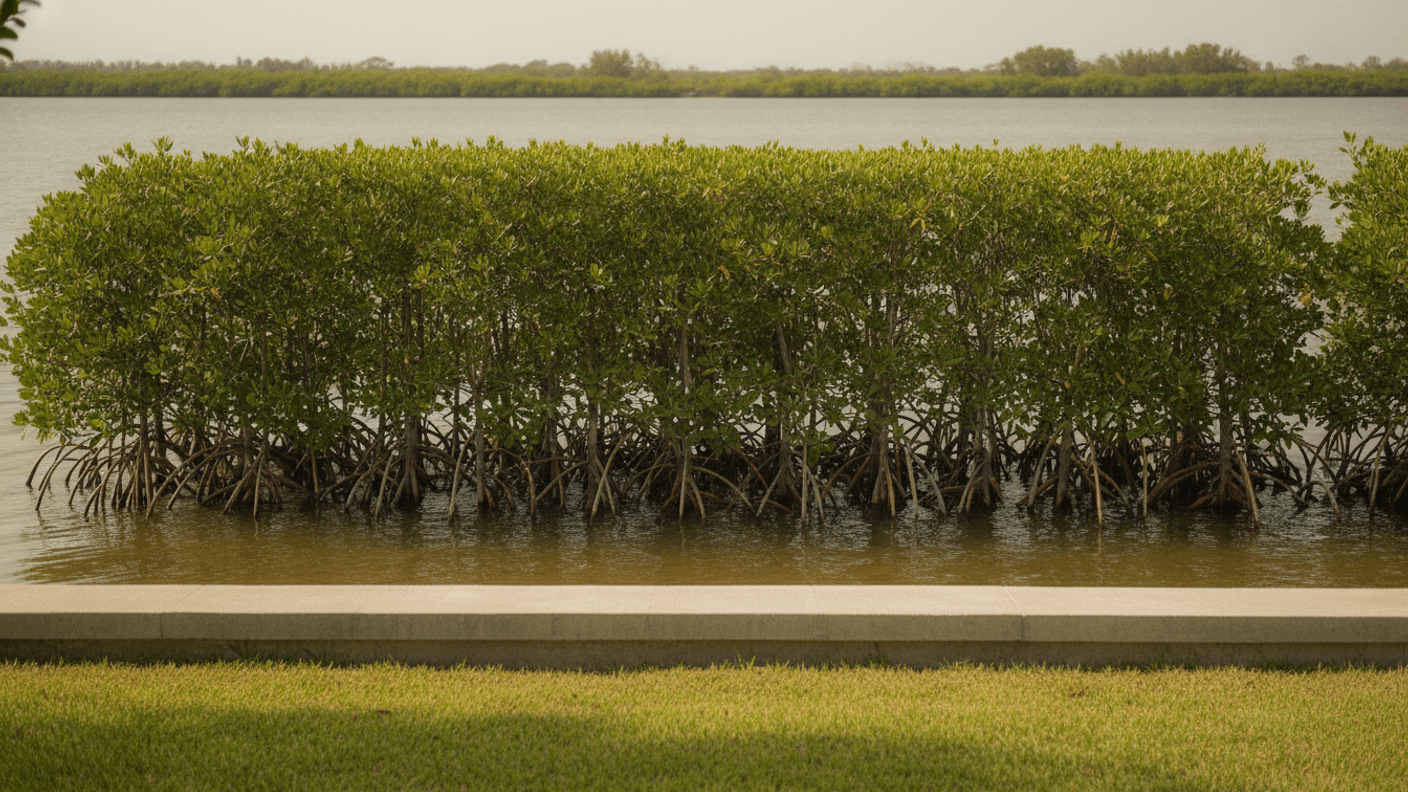
Under Florida’s state exemption, mangrove trimming may qualify without a permit when a riparian fringe is no more than 50 feet deep, mangroves are no taller than 10 feet, and cutting never lowers them below 6 feet. No exemption or general permit allows removal. In Tampa Bay, the agency you answer to depends on your county.
Can you trim mangroves in Florida without a permit?
Sometimes, yes. Some homeowner trimming qualifies for a state exemption, but hitting the measurements isn’t the same as being cleared to cut.
Florida’s Mangrove Trimming and Preservation Act protects white, red and black mangroves. Florida Department of Environmental Protection guidance says dead mangroves follow the same trimming rules as living ones. A dead plant isn’t yours to pull out.
The state homeowner exemption covers qualifying riparian mangrove fringes. Your mangroves have to be no taller than 10 feet before you trim. You can’t cut them down below 6 feet, measured from the substrate.
That exemption applies to properties with 150 feet of shoreline or less. On a longer shoreline, exempt trimming can’t cover more than 65 percent of the mangroves. Reach for a herbicide or a chemical to strip foliage and the exemption is gone.
These are state exemption criteria, not blanket Tampa Bay approval. In some counties a local government runs the whole process instead. Sort out which one applies before you schedule any tree trimming.
Which agency regulates mangrove trimming in Tampa Bay?
It depends on the county your shoreline sits in. Two homeowners with identical mangroves can end up on different paths.
The Environmental Protection Commission of Hillsborough County holds mangrove authority across the whole county. The Florida Department of Environmental Protection handed that authority over in a written delegation order. If you’re on the water in Tampa, Apollo Beach or Ruskin, start with the EPC.
The delegation order draws one line worth knowing. Inside a riparian mangrove fringe, the EPC can’t restrict or qualify the state exemptions, except as the Act allows. Outside a fringe, the EPC may impose stricter standards or more demanding procedures than the state does.
Pinellas County adopted its own Mangrove Trimming and Preservation Code. The county’s guidance calls that code the sole regulation over mangroves in Pinellas County. That’s the path for shorelines around St. Petersburg, Clearwater, Safety Harbor, Tarpon Springs and Gulfport.
If you’re near the city, you can also see how we cover the St. Petersburg tree service area. That page doesn’t stand in for the county’s mangrove process.
In Pasco County, ask which office handles your address. DEP says district offices and delegated local governments process mangrove applications, so one of the two has your file. A quick call settles it before you plan anything.
There’s a reason this matters. Florida’s statutory general permit for riparian owners applies only where DEP hasn’t delegated authority to a local government. Get the jurisdiction wrong and you’re reading the wrong rulebook.
What counts as a riparian mangrove fringe?
It’s the band of mangroves along your shoreline, and it can’t extend more than 50 feet waterward. DEP uses that 50-foot depth as the dividing line.
Pinellas County spells its version out in more detail. For exempt trimming the fringe has to be less than 50 feet deep. You measure perpendicular to the shoreline, from the most landward trunk to the most waterward one.
Height gets measured from the substrate. DEP describes that as the point where the trunk meets the ground. It matters when your mangroves are growing beside a seawall or out into soft bottom.
Take the measurements before you call anyone. Write down your shoreline length, the fringe depth and the height of the plants. That’s what the agency will ask you for first.
The usual reason for asking is a lost water view or a dock you can’t get to. That’s a fair reason to want the work done. It just isn’t what decides whether the work is allowed.
How tall can your mangroves be before you need a professional?
Ten feet is the line. DEP says mangroves taller than 10 feet need a professional mangrove trimmer, though the work can still be exempt from a permit.
Under the state’s professional exemption the ceiling rises to 24 feet of pretrimmed height. Anything 16 feet or taller has to come down in stages. No more than 25 percent of the foliage comes off in a year.
There’s one notice rule worth knowing. A professional mangrove trimmer cutting red mangroves for the first time under that exemption has to give written notice. It goes to DEP or the delegated local government at least 10 days before the work starts.
Florida’s statute names ISA Certified Arborists as professional mangrove trimmers. An arborist consultation gets your measurements on paper and points you at the right agency before anyone touches a saw.
The arborists in our network can confirm which credentials your job actually calls for. They can also walk you through structural pruning when the work has to be staged across seasons.
Being over a height ceiling isn’t a green light. It’s a signal to ask the agency holding jurisdiction what comes next.
What are the mangrove trimming rules in Pinellas County?
Pinellas runs its own code, and its published requirements are the ones that count inside the county. Don’t swap in a general state figure.
Prop roots are off limits. Pinellas says no prop roots may be cut, full stop. Mangroves over 10 feet need a professional mangrove trimmer registered with the county, and that person has to notify Pinellas County Water and Navigation in advance and stay onsite while the trimming happens.
The county measures fringe depth between the most landward and most waterward trunks, perpendicular to the shoreline. Exempt trimming needs that fringe to stay under 50 feet deep.
Pinellas reviews trimming permit applications within 30 days. A permit also comes with a condition people don’t expect: Brazilian pepper, punk tree and Chinese tallow within 25 feet of any mangroves have to be removed.
That last one can turn into a bigger job than you planned for. If it does, the land clearing service is where those questions start, after the county tells you what’s approved.
Pinellas points out that Florida has lost about 86 percent of its mangroves since the 1940s. It also reports that Tampa Bay has lost 50 percent of its historic mangrove coverage. The county publishes both figures right alongside its trimming guidelines.
Why can’t you cut a mangrove below six feet?
Because that’s where the exemptions stop. DEP says cutting below 6 feet takes an individual permit from its district office or the delegated local government.
The 6-foot measurement runs from the substrate. A blocked view, an unreachable dock or a plant that looks dead doesn’t change it. DEP applies the same trimming rules to dead and living mangroves.
Removal is a harder line still. DEP says the trimming exemptions and general permits in the Mangrove Act don’t provide for mangrove removal at all. Heavy trimming isn’t a workaround for removal, and the rules don’t treat it as one.
None of this works like ordinary tree permitting either. For trees away from the water, our guide to tree removal permit rules covers that separate process. It doesn’t apply to a mangrove.
If a shoreline tree looks like it’s struggling, book a tree health assessment. An arborist can document what’s wrong without promising you that cutting it is allowed.
When can you actually do the trimming?
That depends on your agency and your permit, and Tampa Bay has two published calendars that pull in opposite directions.
DEP says trimming between the months of October and March is most desirable. That’s general guidance about the health of the plant. It isn’t a permit condition anywhere.
Pinellas County requires that trimming under a county permit occur between March 1 and November 30. That one is binding on the permit holder. It isn’t advice, and it isn’t a rule for the rest of Florida.
So don’t blend them into one trimming season. If you hold a Pinellas permit, you follow the dates written into it. Everyone else should confirm timing with the agency that has jurisdiction.
Waterfront work usually gets planned around storm season anyway. Our hurricane storm prep service and the Tampa hurricane tree prep checklist cover that side of it.
Palms are a different conversation with different timing. The Florida palm trimming guide explains a common over-trimming mistake. Don’t carry palm habits over to a protected mangrove.
What happens if mangroves are cut illegally?
Bad trimming can turn into a restoration or mitigation obligation under Florida law. The statute sets the threshold at the same 6-foot mark.
Restoration or mitigation kicks in when 5 percent or more of the trimmed mangroves end up below 6 feet in height. That threshold isn’t a small allowance to cut below 6 feet. It’s the point where the state starts counting damage.
The statute also floors one number. An offsite mitigation donation may not be less than $4 per square foot of created wetland area. That’s a minimum on a mitigation donation, not a trimming price and not a fine.
Removal still isn’t available through an exemption or a general permit. If you’re thinking about removing or altering a mangrove, call the agency with jurisdiction first. DEP district offices and delegated local governments are the ones processing those applications.
Have your details ready when you call. Your county, your shoreline length, the fringe depth, the current height and the height you want. That’s what the agency needs to evaluate the work.
Frequently asked questions
Can I trim mangroves to improve my water view?
Possibly, but the view isn’t what makes trimming exempt. The agency looks at jurisdiction, your fringe measurements, plant height and how low you plan to cut. Get the plan confirmed before anything comes off.
Can I remove a mangrove if it blocks my dock?
No exemption or general permit under the Mangrove Act allows removal. Contact DEP or your delegated local government about any proposed alteration. Severe trimming isn’t removal by another name, and it won’t be treated as one.
Do mangrove trimming rules cover dead plants?
Yes. DEP says the mangrove act doesn’t distinguish between living and dead mangroves, so the same trimming regulations apply to each. A dead mangrove isn’t automatically yours to clear.
Can mangrove prop roots be trimmed in Pinellas County?
No. Pinellas County says no prop roots may be cut. Its code is the sole regulation over mangroves in the county, so check with Water and Navigation before you plan anything.
Is an ISA Certified Arborist a professional mangrove trimmer?
Yes. Florida’s statute lists certified arborists certified by the International Society of Arboriculture in that category. Pinellas adds its own registration requirement on top, so your arborist should confirm every qualification your job needs.
Do I need a permit to cut below six feet?
Yes. DEP says trimming below 6 feet requires an individual permit. You apply through the district office or the delegated local government, and which one depends on where the property sits.
Can I collect mangrove seeds from the shoreline?
You don’t need a permit for floating or washed-up non-rooted propagules, which is DEP’s term for mangrove seeds. That’s a narrow exception. It doesn’t let you cut or pull rooted plants.
Tampa Tree Pro connects Tampa Bay homeowners with the right specialist before the first cut. Contact us and we’ll match you with an ISA-certified arborist serving Tampa Bay.