Common questions. Straight answers.
Most of what Tampa Bay homeowners ask before they hire us. Don't see your question? Call us at the number in the header.
Pricing & Cost
How much does tree removal cost in Tampa Bay?
Most tree removals in the Tampa Bay area run $400 to $1,800 for a mid-size tree, with larger oaks or trees close to a house, fence, or power line running $2,000 to $5,000 once a crane is involved. Price depends on trunk diameter, height, how the crew has to access the tree, and whether the wood and debris get hauled away. Crews give you a flat quote before any work starts, so there's no surprise at the end.
How much does tree trimming or pruning cost in Tampa Bay?
Routine trimming for a mid-size tree typically runs $200 to $600, while large canopy oaks that need a lift or extensive structural pruning can run $700 to $1,500. Palms trim cheaper, usually $75 to $250 per tree depending on height and frond count. Crews price by the job, not the hour, so you know the number before they climb.
How much does stump grinding cost?
Stump grinding usually runs $150 to $500 per stump, depending on trunk diameter and how deep you need it ground. Multiple stumps on one property often get a lower per-stump rate when done together. Grinding a stump is faster and cheaper than full stump removal, which pulls the root ball and costs more.
How much does emergency tree removal cost after a storm?
Emergency removal for a tree down on a house, driveway, or power line usually runs higher than a scheduled job, often $600 to $3,000 depending on size and how tangled the tree is with structures or lines. Crews will tell you the fee upfront before they start, even on an emergency call, so you're not guessing at the cost while the tree is sitting on your roof.
Is it cheaper to trim a tree or remove it?
Trimming almost always costs less than removal, but that's not the only thing to weigh. A tree with a cracked trunk, major root damage, or heavy lean toward the house is a removal candidate no matter what trimming would cost, because the risk doesn't go away with a haircut. An arborist can tell you honestly which option actually solves the problem.
Do you charge for estimates in Tampa Bay?
For most standard jobs, estimates are free once a crew has looked at the tree in person. Photos over the phone rarely capture trunk condition, lean, or how close a tree sits to power lines, so most crews want eyes on the actual tree before giving a firm number.
What is crane-assisted tree removal and why does it cost more?
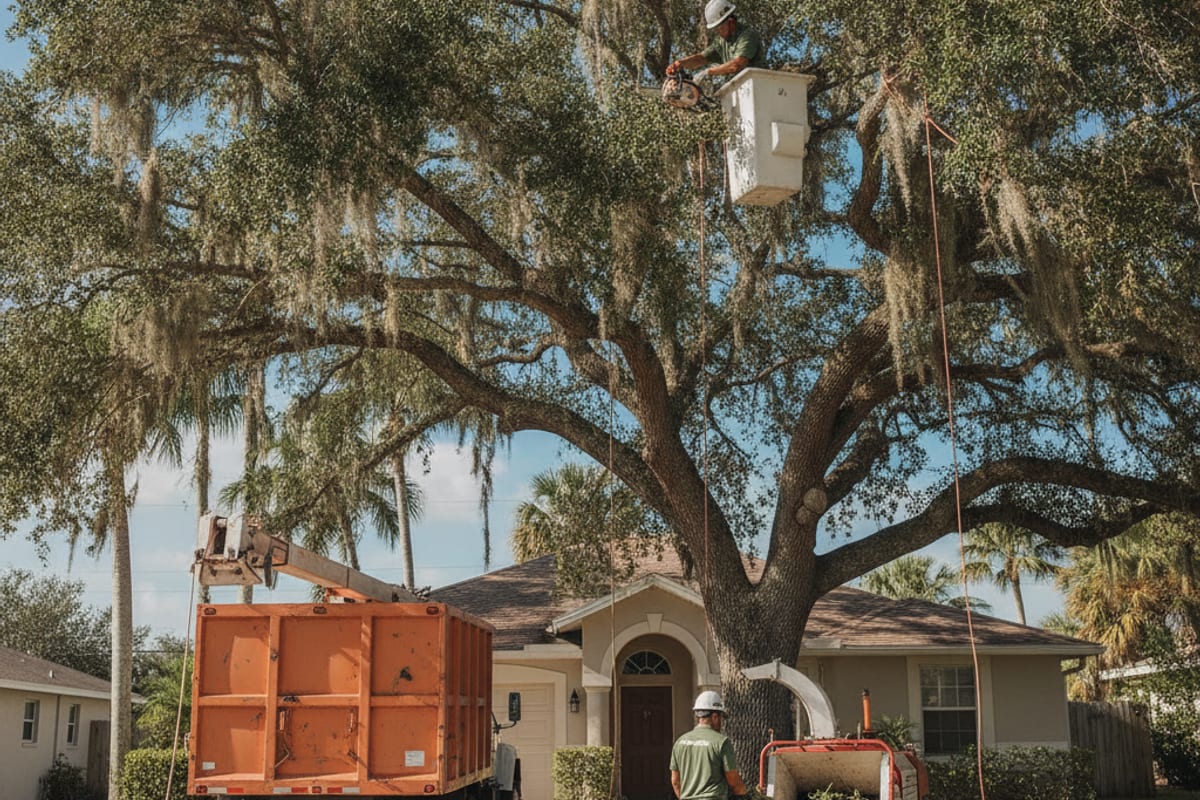
A crane lifts large sections of a tree out and over a house, fence, or pool instead of dropping them, which is the safer option when a tree sits too close to a structure to fell normally. It costs more because it takes extra equipment and a larger crew, usually adding $1,000 to $3,000 to the job, but it's often the only safe way to remove a big oak next to a home.
Permits & Regulations
Do I need a permit to remove a tree in Hillsborough County?
Often yes, especially for larger trees or protected species. Hillsborough County and the cities within it, including Tampa, regulate removal of trees above a set trunk diameter, particularly grand or heritage oaks. The crews we connect you with know the local rules and can pull the permit before any cutting starts.
Are oak trees protected in Tampa and St. Petersburg?
Large, mature oaks are protected in both cities once they pass a certain trunk diameter, and removing one without a permit can mean a fine and a required replacement planting. Dead, diseased, or genuinely hazardous trees usually qualify for removal without the same restrictions, but it still needs documentation. An arborist assessment is the first step either way.
What counts as a protected or grand tree in Tampa Bay?
Most local ordinances define protection by trunk diameter measured at chest height, and grand or heritage trees, usually large old oaks, get extra protection on top of that. The exact threshold varies by city and county, which is why it's worth having a crew check before you plan on removing anything sizable.
Can I be fined for removing a tree without a permit?
Yes. Removing a protected tree without a permit in Hillsborough or Pinellas County can bring a fine and, in some cases, a requirement to plant replacement trees at your own cost. If you're not sure whether a tree on your property is protected, it's worth a quick check before you hire anyone to cut it down.
How long does it take to get a tree removal permit in Tampa Bay?
Straightforward permits for a single tree typically process within a few business days to about two weeks, depending on the city or county and whether the tree is on the protected list. Storm-damaged or clearly hazardous trees often move faster through emergency review. Crews factor permit timing into your project schedule so there are no surprise delays.
Do HOAs in Tampa Bay have their own tree rules?
Many do, on top of city and county ordinances. Some HOAs require board approval before removal, specify which species can be planted as replacements, or have their own list of protected trees within the community. It's worth checking your HOA's covenants before scheduling removal, even if the county wouldn't otherwise require a permit.
Storm & Hurricane Prep
Should I trim my trees before hurricane season?
Yes. A pre-season trim removes weak, dead, or overloaded limbs that are exactly what high wind finds first. Thinning a dense canopy also lets wind pass through instead of catching the whole tree like a sail. Most crews see their busiest pre-storm scheduling in late spring, so it's worth booking before June.
What makes a tree likely to fall in a hurricane?
Shallow root systems, root damage from flooding or construction, a heavy lean, dead or cracked limbs, and disease weakening the trunk all raise the odds. Trees planted in saturated, low-lying soil, common in parts of Tampa Bay, are especially vulnerable because the ground itself loses its grip on the roots during a storm.
Do you offer 24-hour emergency tree removal in Tampa Bay?
Yes. We connect you with crews that run emergency response across Hillsborough, Pinellas, and Pasco counties for trees down on a house, car, fence, or power line. Call (813) 000-0000 anytime and we'll walk you through what's safe to do until a crew arrives.
A tree fell on my house during a storm. What do I do first?
Get everyone out of the affected area and stay clear of any downed power lines near the tree, even ones that look disconnected. Don't climb on the tree or try to cut it yourself. Take photos for insurance if it's safe to do so, then call for emergency removal. A crew will assess whether the tree is stable enough to leave in place until daylight or needs to come off immediately.
Can a leaning tree be saved after a storm, or does it need to come down?
It depends on how much the roots pulled loose. A tree that shifted slightly and still has most of its root plate in the ground can sometimes be straightened and staked. A tree that's uprooted more than a few inches, or one that was already stressed before the storm, usually isn't worth the risk of trying to save. An arborist can tell within a short inspection which situation you're in.
Will insurance cover tree removal after storm damage?
Often, if the tree damaged your home, fence, or another structure. Removal of a fallen tree that didn't hit anything is less consistently covered and depends on your policy. Photograph the damage before cleanup starts and check with your insurer, since some require documentation before a crew begins work.
How do I know if a tree is a hurricane risk before the storm hits?
Warning signs include a visible lean that's gotten worse, mushrooms or fungus growing at the base, cracked or hollow-sounding trunk sections, and large dead limbs in the canopy. Root damage from recent construction or flooding also raises the risk even if the tree looks fine above ground. A pre-season inspection catches most of this before wind puts it to the test.
Tree Health & Care
What is laurel wilt and is it killing my tree?
Laurel wilt is a fungal disease spread by the redbay ambrosia beetle that has killed large numbers of native trees across Florida, especially redbay and swamp bay, and it can affect avocado trees too. Symptoms include rapid wilting and browning of leaves that stay attached to the branch instead of falling, often starting at the top of the canopy. There's no reliable cure once a tree is heavily infected, so early removal of infected trees helps slow the spread to healthy ones nearby.
Why are my oak leaves turning brown and wilting?
This can mean several things: root stress from flooding or drought, a fungal or bacterial infection, or in some cases a beetle-spread disease. Live oaks and laurel oaks are common across Tampa Bay and generally hardy, but sudden wilting that spreads fast is worth a same-week look rather than waiting to see if it clears up on its own.
What is lethal bronzing in palm trees?
Lethal bronzing is a bacterial disease spread by insects that has been moving through Florida's palm population, affecting sabal palms, queen palms, and several others. Early signs include premature fruit drop and discoloration in the lower fronds, progressing upward until the palm dies. There's no cure once symptoms show, though preventive treatment can protect palms near an infected one. Catching it early matters.
What is ganoderma butt rot?
Ganoderma is a fungus that attacks the base and root system of a tree from the inside, often with no visible symptoms until a shelf-like mushroom, called a conk, appears at the trunk base. By the time the conk shows up, the internal decay is usually advanced and the tree's structural stability is compromised. There's no effective treatment, and a tree with ganoderma near a house or driveway typically needs to come down before it fails on its own.
How can I tell if a tree is dying or just dormant?
A quick check is the scratch test: nick a small section of bark on a branch. Green underneath means the branch is alive; brown and dry means it's dead. Widespread dead branches, bark falling off in sheets, mushrooms at the base, or a canopy that's thinner than last year are all signs pointing toward decline rather than normal seasonal change.
Can a sick tree be saved, or does it need to come down?
It depends on what's wrong and how far it's progressed. Nutrient deficiencies, minor pest issues, and early-stage disease often respond to treatment. Advanced root rot, heavy structural decay, or a disease with no cure, like lethal bronzing in a late stage, usually mean removal is the safer and more honest call. An arborist assessment is the way to know which situation you're in before spending money on treatment that won't hold.
How often should trees be inspected for health and storm risk?
Once a year is a reasonable baseline for most yards, with an extra check after any major storm. Older trees, trees near your house or a power line, and any tree already showing signs of stress are worth checking more often, closer to every six months. Regular inspection catches problems while they're still cheap to fix.
Removal & Trimming
When is the best time of year to trim trees in Florida?
Late winter to early spring, before new growth starts, is generally the best window for structural pruning, though dead or hazardous limbs should come off whenever you spot them regardless of season. Avoid heavy pruning during active hurricane season unless it's storm prep, since trees put energy into healing cuts and a major storm right after heavy pruning adds stress.
How do I know if a tree needs to be removed instead of trimmed?
Trimming solves problems with individual limbs. Removal is usually the right call when the trunk itself is compromised, root damage is significant, the tree has a severe lean toward a structure, or a disease has advanced past the point of treatment. If more than a quarter of the canopy is dead, that's often a sign the whole tree is in decline, not just a branch or two.
Do you use cranes for large tree removals?
Yes, when the tree's size or location calls for it. Crews use cranes to lift large sections out over a house, pool, or fence line instead of dropping them, which is the safer approach when a tree sits too close to something valuable to risk a standard felling cut.
What happens to the tree after it's removed? Do you haul it away?
Standard removal quotes usually include hauling the wood and debris away, but it's worth confirming before the job starts since some quotes price debris removal separately. Larger trunk sections sometimes get left as firewood rounds if you want them, or fully hauled off if you don't. Ask upfront so there's no confusion on job day.
Can you remove a tree close to my house or power lines?
Yes, this is common work, but it changes how the job gets done. Trees near structures or lines are usually removed in sections rather than felled whole, sometimes with a crane, and crews coordinate with the utility company when a tree is tangled with power lines rather than cutting near live wires themselves.
How long does a typical tree removal take?
A single mid-size tree usually takes a few hours from setup to cleanup. Larger trees, ones requiring a crane, or jobs with multiple trees can stretch into a full day. Crews will give you a realistic time estimate when they quote the job so you know what to expect.
Will removing a tree damage my yard or driveway?
Some disturbance is normal, especially near the stump and along the path equipment takes to access the tree. Experienced crews use plywood or mats to protect turf and pavers when heavy equipment is involved, and stump grinding leaves a shallow crater that's easy to fill and reseed. Ask the crew how they plan to protect your yard before the job starts if it's a concern.
Palm Trees
Do sabal palms need regular trimming?
Yes, though less often than most trees. Sabal palms, Florida's state tree, generally need trimming once or twice a year to remove dead fronds and old fruit stalks. Over-trimming, sometimes called hurricane cutting where all but the newest fronds get removed, actually weakens the palm and makes it more vulnerable in storms, so more isn't better here.
How often should queen palms be trimmed in Tampa Bay?
Queen palms typically need trimming two to three times a year since they grow faster and drop fronds more often than sabal palms. Keeping dead fronds cleared also removes a common hiding spot for pests and reduces debris that becomes a hazard during high wind.
Can palm trees be saved from lethal bronzing?
Once symptoms appear, there's no cure, and an infected palm should be removed to protect healthy palms nearby. Preventive antibiotic treatment can protect palms that are still healthy but located near a known infected tree. If you have palms in an area where lethal bronzing has been confirmed, ask about preventive treatment before symptoms show up.
Are palm trees native to Tampa Bay protected the same as oaks?
Protection rules vary. Sabal palms are Florida's state tree and get some consideration in local ordinances, but the specific protections and size thresholds differ from those covering oaks. Check with your city or county before removing a mature palm, especially in neighborhoods with tree canopy requirements.
Stump Grinding & Land Clearing
What is the difference between stump grinding and stump removal?
Grinding chews the stump down below grade using a machine, leaving the root system in the ground to decompose naturally over time. Full removal pulls the stump and major roots out entirely, which costs more and disturbs a larger area. Grinding is faster, cheaper, and enough for most homeowners who just want to reclaim the yard space or plant grass over it.
Can I plant grass or a new tree over a ground stump right away?
Grass, usually within a week or two once the ground settles and fresh topsoil is added over the ground-up wood. A new tree in the same spot needs longer, since the old root system is still breaking down underground and can interfere with new roots. Most crews recommend waiting several months to a year before planting a tree in the exact same spot.
Do you handle land clearing for new construction lots in Tampa Bay?
Yes, crews connected through this network handle lot clearing for new builds, additions, and driveway or pool projects that need trees and brush cleared first. Larger clearing jobs typically need their own permit separate from a standard single-tree removal, especially if protected trees are on the lot.
How deep does stump grinding go?
Standard grinding goes 4 to 6 inches below grade, which is enough for grass and most landscaping. Deeper grinding, sometimes 12 inches or more, is available if you're planning to plant something with a larger root system in that exact spot, though it costs more and takes longer.
Service Area & Scheduling
What areas do you serve in Tampa Bay?
We serve Hillsborough, Pinellas, and Pasco counties, including Tampa, St. Petersburg, Clearwater, Brandon, Wesley Chapel, New Port Richey, and everywhere in between. That covers dense urban neighborhoods with mature canopy, coastal areas with salt-tolerant species, and the newer master-planned suburbs pushing out toward Wesley Chapel and Land O' Lakes. If you're not sure whether your address falls in our service area, call (813) 000-0000 and we'll let you know right away.
How quickly can you get someone out for a non-emergency job?
For standard appointments, scheduling usually runs one to five business days depending on the season, with the weeks before hurricane season and right after a major storm being the busiest stretch. Emergency calls, like a tree down on a structure, get priority same-day response.
Do you offer free estimates for tree removal?
Yes, crews come out and look at the tree, its location, and access before giving a firm quote. Tree work has too many variables, like trunk lean, proximity to structures, and access for equipment, to price accurately without seeing it, so a walkthrough comes before the number.
Can you work on properties with mobile or manufactured homes?
Yes. Pasco County especially has a large share of mobile and manufactured home communities, particularly around New Port Richey, Holiday, and Land O' Lakes, and tree work there often needs extra care around tighter lot lines and utility pedestals. Crews connected through this network are experienced working on these properties.
Do you work with HOAs and property managers?
Yes, crews regularly handle work for HOAs and property managers on common areas, entrance landscaping, and individual homeowner requests that need board sign-off. If your community has a preferred vendor process or requires specific documentation, let the crew know upfront so paperwork doesn't hold up scheduling.
Ready for a tree crew that actually answers the phone?
Call for a free quote. Same-day service on most repairs.