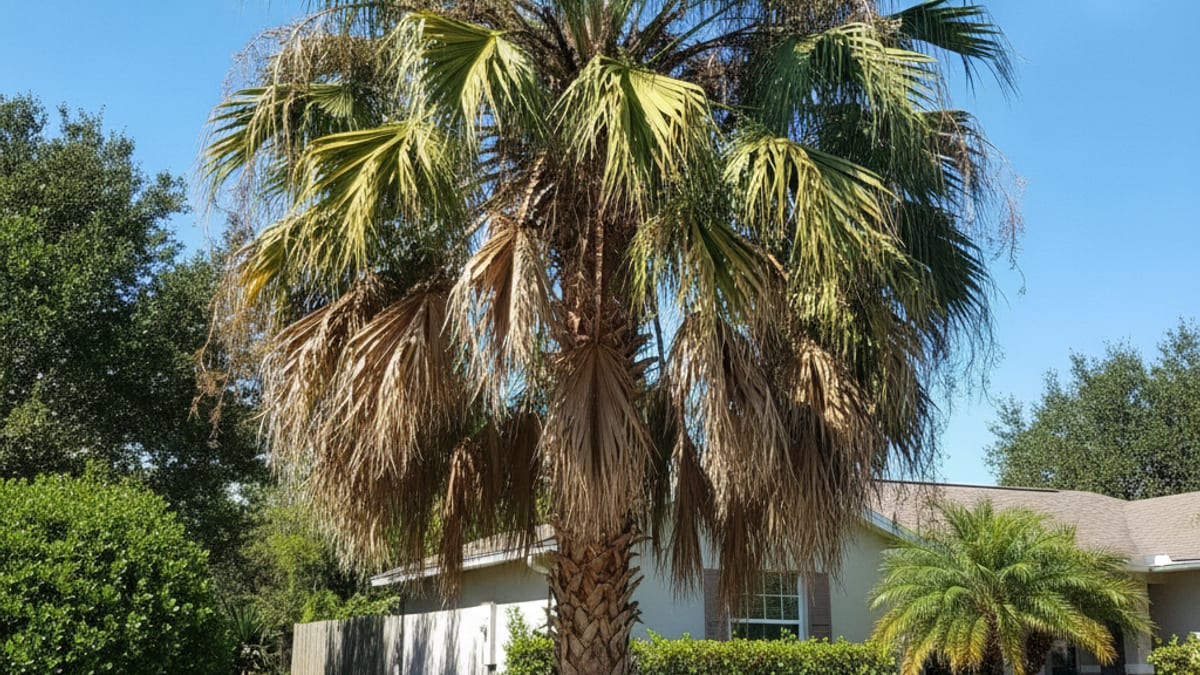
Sabal palms line the medians on Bayshore Boulevard, shade backyards from New Port Richey to Riverview, and stand watch over pool decks throughout the region. They’re Florida’s state tree for a reason: they’re tough, familiar, and mostly low maintenance. Which is exactly why lethal bronzing catches so many homeowners off guard. A palm that’s needed almost nothing from you for a decade can start dying in a matter of months, and by the time it’s obvious, treatment options are already limited.
Here’s what the disease actually does, which palms are at risk in Tampa Bay, and what’s worth doing about it before symptoms show up in your own yard.
What lethal bronzing is
Lethal bronzing (formerly known as Texas Phoenix Palm Decline) is caused by a phytoplasma, a bacteria-like organism that lives in the palm’s vascular tissue and is spread from tree to tree by a small planthopper insect that feeds on infected palms and carries the pathogen with it. Once a palm is infected, the phytoplasma disrupts the flow of nutrients through the trunk, and the tree begins a fairly predictable, and unfortunately fatal, decline.
It was first identified in Florida in the mid 2000s and has spread across much of the peninsula since, including Hillsborough and Pinellas county. It’s one of the more serious palm health threats in the state right now, alongside Fusarium wilt and ganoderma butt rot, precisely because it moves tree to tree via an insect vector rather than staying contained to one weak specimen.
Which palms are actually at risk
Lethal bronzing has a fairly wide host range among Florida’s common landscape palms, which is part of what makes it worth watching for regardless of what species you have planted.
Sabal palms (cabbage palms), Florida’s state tree and the most common palm in the region, are highly susceptible and represent a large share of documented cases. Phoenix species, including Canary Island date palms and Sylvester palms, are also highly susceptible and tend to show textbook symptoms. Queen palms get hit as well, though somewhat less frequently than sabal and Phoenix species. Even coconut palms, less common this far north but present in warmer pockets of the bay, are on the host list.
Because sabal palms make up so much of the Tampa Bay landscape, both in yards and along public rights of way, the sheer number of susceptible trees in range of an infected planthopper population is part of what makes this disease worth taking seriously here specifically, not just in South Florida.
The symptom pattern to watch for
Lethal bronzing follows a fairly recognizable progression, and catching it early genuinely changes your options.
Stage one: premature fruit drop
In fruiting palms, one of the earliest signs is unripe fruit or flower stalks dropping prematurely, before the more obvious frond symptoms appear. It’s an easy sign to miss if you’re not specifically looking at the crown of the palm rather than the fronds.
Stage two: bronzing from the bottom up
The signature symptom, and where the disease gets its name, is a progressive bronzing or reddish brown discoloration that starts in the oldest, lowest fronds and moves upward through the canopy over weeks to a few months. Unlike normal frond aging, which is gradual and affects individual fronds at different times, lethal bronzing bronzing tends to move through the canopy in a more uniform wave.
Stage three: spear leaf collapse
As the disease progresses, the newest, innermost frond (the spear leaf) eventually browns and collapses, even though it’s the youngest growth on the tree. This is a critical marker because once the spear leaf has collapsed, the palm’s growing point (the bud) is typically already dead or dying, and the decline becomes irreversible.
Stage four: bud death
Once the bud is dead, the palm cannot produce new growth. The remaining canopy will continue to bronze and die over the following weeks, and the tree cannot recover from this stage regardless of any treatment applied. At this point, removal is the only real option.
What can be done before it’s too late
The single biggest factor in outcome is timing. Preventive antibiotic trunk injections (typically oxytetracycline) can protect high-value palms in areas where lethal bronzing is active nearby, and this is worth discussing for a prominent, mature sabal or Phoenix palm you’re not prepared to lose, especially if you’ve seen the disease show up on neighboring properties. These injections are preventive and need to be repeated on a regular schedule; they aren’t a one-time fix.
For a palm already showing early bronzing symptoms but before spear leaf collapse, treatment can sometimes slow or halt progression, though results vary and aren’t guaranteed once symptoms have already started. This is a case where getting a professional look at the first sign of bronzing, rather than waiting to see if it spreads, meaningfully changes the odds. A palm tree service crew that regularly works with Florida palm diseases can tell you honestly whether a given tree is still a treatment candidate or past that window.
Once the spear leaf has collapsed, there’s no treatment that reverses the decline. At that stage the priority shifts to safe removal, both because a dead palm crown eventually sheds heavy fronds unpredictably, and because a dead palm can continue attracting the planthoppers that spread the disease to healthy palms nearby.
Telling lethal bronzing apart from other palm problems
Not every discolored or declining palm has lethal bronzing, and mistaking one problem for another can waste time you don’t have with a genuinely infected tree. Nutrient deficiency, especially potassium or magnesium deficiency, is extremely common in Florida palms and causes yellowing or orange discoloration in older fronds that can superficially resemble early bronzing, but it typically progresses much more slowly, responds to proper fertilization, and doesn’t involve the spear leaf collapse that marks lethal bronzing’s later stages. Ganoderma butt rot, caused by a different fungus entirely, attacks the base of the trunk and produces a shelf-like conk near the soil line, with canopy decline that tends to be more uniform rather than progressing bottom to top the way lethal bronzing does. Simple drought stress or transplant shock in a recently planted palm can also cause frond browning that looks concerning but has nothing to do with disease. A proper tree health evaluation is the difference between treating the actual problem and guessing based on how the fronds look from across the yard. Lightning belongs on that list too, since UF/IFAS names lethal yellowing among the causes its symptoms get confused with; our guide to a palm struck by lightning covers how fast those symptoms arrive.
Reducing spread on a property with multiple palms
If you’ve got a stand of sabal palms, which is common on larger Tampa Bay lots and along canal or lake frontage, one infected palm is a risk to the others nearby because of how the planthopper vector operates. Removing a palm that’s already past the point of saving, rather than leaving a dead or dying specimen standing, reduces the local population of insects that could carry the phytoplasma to your remaining healthy palms. If you’re dealing with multiple palms on one property, it’s worth having all of them assessed together rather than one at a time as each shows symptoms.
Removing and replacing a palm that’s past saving
Once a palm has reached bud death, removal is generally the safest path forward, both for the reasons already covered around insect spread and because a dead palm crown eventually loses structural integrity and can drop heavy fronds or the entire canopy unpredictably. Palm tree removal is typically priced by height rather than trunk diameter, since most of the work involves managing the tall, narrow trunk section by section rather than breaking down a wide canopy the way a hardwood removal does.
If you’re replanting after losing a palm to lethal bronzing, it’s worth talking through species selection with whoever handles the removal. Some Florida palm species show more natural resistance than others, and diversifying rather than replanting the exact same species in the exact same spot can reduce the odds of losing the replacement to the same disease if the local beetle population is still active in the area.
Getting your palms checked
Because the window for effective treatment is narrow and closes fast once bronzing starts, the best move for a valuable or prominent palm is a baseline health check before you see any symptoms at all, especially if lethal bronzing has been reported in your neighborhood. We can connect you with a local arborist experienced in Florida palm health to evaluate your palms and talk through whether preventive treatment makes sense for your property.