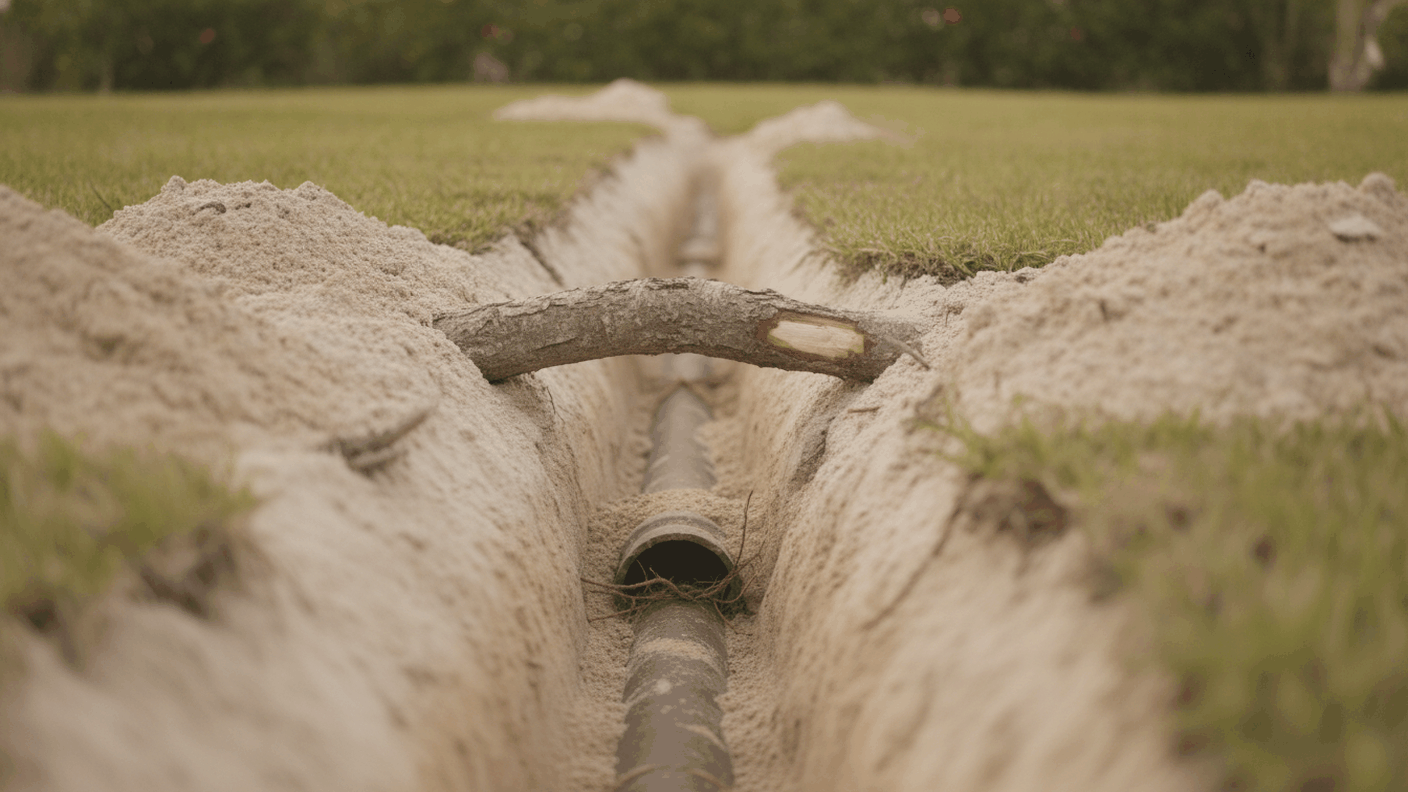
The sewer pipe running from your house out toward the street is yours, and that catches most Tampa Bay homeowners off guard. It’s called a lateral, and the Tampa Bay Estuary Program says maintaining it is the owner’s responsibility. Here’s the part that matters when there’s a big tree in the yard: roots get in through a crack or an opening that’s already there. Cutting the tree down doesn’t close that opening. What can help is money, because Pinellas County Utilities and the City of St. Petersburg both publish rebate programs for this repair, and one of them is currently a full rebate in the neighborhoods it covers.
Who owns the sewer line between your house and the street?
You do, for the stretch called the lateral, which is the pipe connecting your house to the public sewer.
The Tampa Bay Estuary Program puts it plainly: the homeowner is responsible for maintaining the lateral sewer line. That’s a different piece of pipe than the main the utility looks after, and the difference is the whole ballgame when something goes wrong.
St. Petersburg draws the boundary in its own words. Laterals there are private property, and property owners maintain them from the home up to the property line.
Where that boundary sits can vary from one utility to the next. Ask yours where its responsibility starts before you approve any work, then have a licensed plumbing contractor look at the private side.
How do tree roots get into a sewer line?
Through a defect or an opening that’s already in the pipe.
That’s the EPA’s own framing: tree roots entering through defects or openings in a sewer line may cause blockages. The Tampa Bay Estuary Program describes the same sequence from the local end, saying cracks in the lateral line can lead to tree root invasion, leaks and back-ups.
So the opening is the thing. Clearing roots reopens the flow, and it does nothing about the gap that let them in. That gap is still a job for a licensed plumbing contractor.
St. Petersburg lists what actually makes laterals fail, and roots are one entry on the list. The others are pipe corrosion, calcification, scale build-up, settlement from shifting soil, and damaged cleanouts. Worth remembering before anyone blames the oak.
A soggy patch in the yard won’t tell you what’s happening under it. Neither will the size of the tree next to the cleanout. Somebody has to look inside the pipe.
Does removing the tree fix a root-blocked sewer line?
No. Taking the tree out doesn’t close a crack or an opening in the lateral.
The defect is still there the morning after the crew leaves, and it’s still a plumbing job. A licensed plumbing contractor decides what the pipe needs, whether that’s clearing, a spot repair, lining, or a full replacement.
Whether the tree goes is a separate question, and it turns on the tree’s condition and where it’s standing. An arborist can tell you if it’s worth keeping. When both trades end up on the property, they should be talking to each other.
Our guide to stump grinding versus removal covers the stump side of that decision, and it’s right that grinding leaves the root system in the ground. What it doesn’t do, and what full removal doesn’t do either, is fix the pipe.
How do you find out whether roots are actually in the pipe?
You send a camera down it. A licensed plumbing contractor runs a scope through an accessible cleanout and watches the inside of the pipe.
That footage shows openings, root intrusion, build-up and damaged sections. It also settles the argument, because a tree standing near a cleanout isn’t evidence of anything on its own.
The Tampa Bay Estuary Program says most camera scope inspections cost a few hundred dollars. Get that in writing before you authorize it.
Pinellas County draws a harder line on it. A CCTV inspection by a plumber certified or registered with the Pinellas County Contractor Licensing Board is the only way to know whether a lateral is defective and in need of replacement, and the county ties its rebate to that requirement.
Cleanouts have a habit of hiding beside a fence, under a patio, or in the middle of a planted bed. Tell the plumber about access before the appointment, not during it. If tree work follows, hand the arborist the footage.
What will St. Petersburg or Pinellas County pay toward the repair?
Both of them publish real money for this, and the two programs work differently.
Pinellas County Utilities lists these private sewer lateral rebates:
- The inspection rebate covers 100% of the inspection cost, up to $350.
- The repair, full replacement or lining rebate covers 50%, up to $3,500.
- A complete application is due within 90 days of the work being completed.
Pinellas also says the rebates are limited and go out first come, first served until the funds run out. So confirm eligibility, funding, contractor requirements and deadlines with Pinellas County Utilities before you commit to anything.
The county runs a separate Find and Fix program on top of that, covering three priority areas in Largo, Seminole and St. Petersburg. Pinellas says that if you’re in one of those focus areas and you’ve received a letter about the program, you don’t need to apply for the rebate, because your lateral will be inspected and repaired, if needed, as part of Find and Fix at no cost to you. Check with the county about your address.
The City of St. Petersburg funds its own lateral rehabilitation rebate:
- Phase 1 is a full rebate for inspection and rehabilitation costs.
- Phase 2 is up to $5,000 for inspection and rehabilitation costs.
- Phase 1 opened in June 2025.
- Phase 2 is anticipated to launch in October 2026.
One rule there is worth reading twice: the City requires homeowners to receive an official approval letter before scheduling an inspection or proceeding with rehabilitation work, and it says not to start with a plumbing contractor until that approval has been issued. Confirm current terms, funding and eligibility with the City.
If you’re sorting out the yard at the same time, our St. Petersburg tree service and Largo tree service pages cover what we handle locally. That’s tree work, not sewer repairs.
What about Tampa and Hillsborough County customers?
The two programs above belong to the City of St. Petersburg and Pinellas County Utilities. If you’re on another Tampa Bay system, ask your own utility what it offers.
Program names, eligibility rules and approval steps all vary by service area, so don’t assume a rebate at one address travels to another. The utility is also the right place to ask where its responsibility ends and yours begins.
The inspection itself is the same either way. A licensed plumbing contractor scopes the lateral, and you decide what to do with what the camera shows.
Which Tampa Bay laterals are most likely to have this problem?
The older ones. There’s a date on this, and it’s 1975.
The Tampa Bay Estuary Program says homes built before 1975 are more likely to have lateral lines made of materials that break down over time, naming orangeburg and cast iron. It also connects the dots for you: cracks in the lateral line can lead to tree root invasion, leaks and back-ups. Old material, then a crack, then roots.
St. Petersburg lists the materials that turn up in private laterals around here:
- Vitrified clay
- Orangeburg
- Polyvinyl chloride, or PVC
- Galvanized steel
- Cast iron
Material by itself doesn’t prove a lateral has failed. Corrosion, settlement from shifting soil and a damaged cleanout sit on that same list of causes. The camera is still more useful than the year the house was built.
And go easy on the tree until somebody’s looked. Roots in the pipe confirm there’s an opening. They don’t explain what made it.
Should you have the lateral scoped before buying an older Tampa Bay home?
Nobody’s going to make you, and that’s exactly why it’s worth doing.
The Tampa Bay Estuary Program says lateral sewer line inspections are not required before purchasing a home. The same page points out that older materials break down and that cracks let roots in. Put those two facts next to each other and you can see the trap.
So ask a licensed plumbing contractor whether a scope makes sense for the property, and ask the utility where its responsibility ends. Between those two answers you’ll know which part of that pipe becomes your bill.
Keep the recording and the written findings either way. If roots show up near a tree you’d rather keep, an arborist can work from them.
When is the tree the thing that actually needs to be dealt with?
When the tree has its own problem, judged on its own terms. Condition, structure, where it’s standing. If the roots in question come from a neighbor’s tree, our guide to overhanging tree branches in Florida covers the trimming right and where it stops.
An arborist can tell you whether it’s healthy enough to keep, what pruning would buy you, and what removal would do to the rest of the yard. Our arborist consultation connects homeowners with ISA-certified arborists in the network.
Protected status changes the removal question completely, and your address decides the rules. Our Tampa tree removal permit guide walks through that, and the guide to protected grand oaks covers what happens when the tree in question is a big one.
If it does need to come out, our tree removal service puts you in front of insured crews across the Tampa Bay area. They handle the tree. The plumber handles the pipe.
The stump is its own call after that, and our stump grinding service deals with the obstruction in the yard. It’s not a sewer repair, and it doesn’t close anything underground.
What order should you do all this in?
Pipe first, tree second. That order matters more than it sounds like it does.
- Ask the utility which stretch of lateral it maintains and which stretch you do.
- Hire a licensed plumbing contractor to scope the pipe.
- Ask for the recording and the written findings.
- Read your utility’s rebate rules before you authorize any covered work.
- Get whatever approval that program requires, in writing, before scheduling.
- Bring in an arborist to look at the tree on its own.
- Coordinate yard access if both crews are going to be out there.
Do it this way and tree work never gets used as a substitute for a diagnosis. It also keeps you inside the rules of a program that wants approval first.
Frequently asked questions
Who is responsible for tree roots in a sewer line?
You are, for the private lateral running from your home toward the public system. The Tampa Bay Estuary Program says the homeowner is responsible for maintaining the lateral sewer line. Ask your utility to confirm exactly where that boundary sits at your address.
Do tree roots break into an intact sewer pipe?
Roots get in through defects or openings, which is how the EPA describes it, and then they may cause blockages. A camera inspection shows the opening and the section of pipe it’s in.
Can Tampa Tree Pro clear roots from a sewer line?
No. Tampa Tree Pro connects homeowners with tree crews and ISA-certified arborists. Inspecting, clearing, repairing, lining or replacing a lateral is a licensed plumbing contractor’s work.
Will removing the tree repair the damaged pipe?
No. Removal doesn’t close a crack or an opening. That defect is still a separate repair, and it still belongs to a licensed plumbing contractor.
Are sewer lateral rebates available around Tampa Bay?
St. Petersburg and Pinellas County Utilities both publish one, described above. What you actually qualify for depends on that utility’s current terms and remaining funding. On any other system, ask your own utility.
Should the plumber or the arborist come first?
The plumber. Get the pipe documented, then let an arborist read the findings alongside the tree and the yard before anyone decides about removal.
Talk to Tampa Tree Pro about the tree
We handle the tree side of this, across the Tampa Bay service area, around the clock when it can’t wait. We’ll connect you with insured crews or an ISA-certified arborist in our network.
The plumber takes the pipe. The arborist takes the tree. Get in touch when you’re ready for that second conversation.