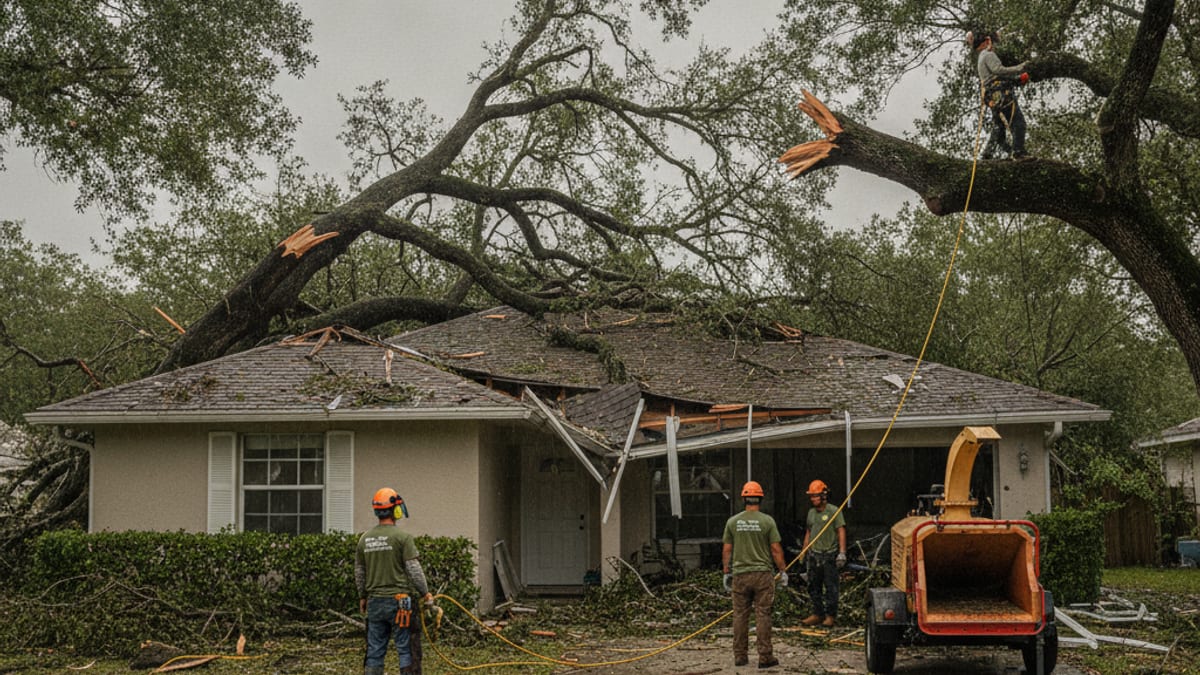
The wind has died down, the rain has stopped, and there’s a tree lying across your roof. Whatever you were planning to do today just changed. In the first few minutes after a tree comes down on a house, the decisions that matter most aren’t about the tree at all, they’re about safety, and the order you handle things in affects both how safe your family stays and how smoothly the insurance and repair process goes afterward.
Here’s the sequence to actually follow, in order.
First: get everyone out and account for people
If the tree hit a part of the house where anyone is, or if there’s visible structural damage, a compromised ceiling, a sagging section of roof, or windows that shattered, get everyone out of that area immediately. Don’t wait to assess how bad it looks. Tree impacts can cause structural damage that isn’t obvious right away, and a ceiling or partial roof section that held during the impact can still fail afterward as weight shifts or additional weather moves through.
Once everyone’s confirmed safe, do a basic check for anyone hurt. Even if it looks like nobody was near the impact, a quick account of everyone in the house is worth doing before anything else.
Second: check for immediate hazards before going back near the house
Downed power lines are the most dangerous thing likely to be near a fallen tree, and after a storm they can be tangled in branches or hidden under leaves where you won’t see them until it’s too late. If you see any wires touching or near the tree, treat the entire area as live and stay well back, even if the power in your house is out. A line can still be energized from the street side even when your home has lost power. Call the utility company immediately if you spot this, and don’t attempt to move any part of the tree until they’ve confirmed it’s safe.
Check for gas smells near the house too, especially if the impact was significant enough to shift foundation elements or utility connections. If you smell gas, leave the property and call the gas company or 911 from a safe distance rather than investigating further yourself.
Third: document everything before anything gets moved
Once the immediate safety concerns are handled, take photos and video from multiple angles before any cleanup starts, both of the tree itself and the damage to the house. Get wide shots showing the tree’s position relative to the structure, and close-ups of specific damage: roof penetration, siding damage, broken windows, anything visibly cracked or displaced. Insurance adjusters work faster and more accurately with thorough documentation, and once a crew removes the tree, some of that visual evidence is gone for good.
If it’s safe to do so, also photograph the base of the tree and the root ball if it uprooted, since this can help establish whether the tree was healthy or had preexisting decay, which sometimes matters for how a claim gets evaluated.
Fourth: call your insurance company
Contact your homeowner’s insurance provider as soon as you’ve documented the damage, even before repair work starts. Most policies cover tree removal and structural repair when a tree falls on a covered structure due to a storm, though coverage details vary by policy, so this is a conversation to have directly with your adjuster rather than assuming based on what a neighbor’s policy covered. Ask specifically whether emergency tarping or temporary protective measures are covered, since getting the exposed area protected from further water damage is usually the next urgent step.
Fifth: get emergency tree removal, not a general contractor first
This is where people sometimes get the order backward. Before roofers or general contractors can safely assess or begin repair work, the tree itself typically needs to come off the structure, and that’s a job for a crew equipped for emergency tree service, not general storm cleanup. A tree resting on a roof is under load in ways that make standard cutting techniques dangerous, since removing sections in the wrong order can cause sudden shifts that drop weight through an already compromised roof structure.
An experienced emergency crew will assess how the tree is loading the structure before cutting anything, often removing weight from the top down in controlled sections rather than cutting at the base first, which could let the whole tree drop at once. For larger trees or ones in awkward positions relative to the house, this sometimes requires crane-assisted removal to lift sections away cleanly without additional impact to the roof or walls.
What to avoid doing yourself
Don’t climb on the roof to assess damage, even if it looks stable from the ground. Storm-damaged roofs can have hidden structural weaknesses that aren’t visible until someone’s weight is on them. Don’t attempt to cut or move any part of the tree yourself, especially if it’s under tension, meaning branches are bent, pinned by the tree’s weight, or leaning against the house in a way that could release suddenly if cut in the wrong spot. This is one of the more dangerous DIY mistakes homeowners make after a storm, and it causes serious injuries every hurricane season.
Don’t wait on tarping the exposed area if rain is still in the forecast, since water intrusion after the initial impact often causes more total damage than the tree strike itself, particularly to insulation, drywall, and electrical systems inside the affected area.
What happens after the tree comes off
Once the tree is safely removed, that’s when a roofer or general contractor can properly assess the structural damage and begin repairs. Many Tampa Bay tree service crews coordinate directly with the homeowner’s timeline for this handoff, since getting the property protected and dried in quickly matters for preventing secondary damage.
If the tree that fell was on your property and there are other trees nearby that survived the storm but show new leaning, cracking, or root disturbance from the same wind event, it’s worth having those assessed too before the next system comes through. A storm that took one tree down often stressed the root systems of others nearby, even ones that didn’t fail this time.
If it was a neighbor’s tree, not yours
Trees don’t respect property lines when they fall, and a fair number of the calls Tampa Bay crews get after a storm involve a neighbor’s tree landing on someone else’s roof. In most cases, whichever homeowner’s structure was damaged files the claim with their own insurance, regardless of whose property the tree originated from. Florida generally treats storm-related tree falls as an act of nature rather than a liability issue, unless the tree’s owner had clear prior knowledge that it was dead, diseased, or hazardous and failed to address it.
That distinction can matter for your claim, so if you know the tree had visible problems before the storm, standing dead, an obvious lean, fungal conks at the base, note that in your documentation and mention it to your adjuster. It won’t always change the outcome, but it’s relevant information the insurance company should have. Talking to your neighbor directly and keeping the conversation cooperative rather than adversarial tends to make the whole process smoother for both households, since you may need access to their side of the property line to complete the removal safely. For the standing-tree version of this question, before anything falls, our guide to overhanging tree branches in Florida covers who trims and who pays.
Renting instead of owning
If you’re a renter rather than a homeowner, the sequence above still applies for personal safety, but the insurance and coordination steps shift. Contact your landlord or property manager immediately after confirming everyone’s safe, since the property owner typically holds the insurance policy covering structural damage and is responsible for arranging emergency tree removal and repairs. Your own renter’s insurance, if you have it, generally covers your personal belongings rather than the structure itself, so it’s worth understanding which policy covers what before you’re in the middle of an emergency.
Don’t wait on a landlord who’s slow to respond if there’s an active safety hazard like a downed power line or exposed roof during ongoing rain. Calling the utility company or getting emergency tarping started yourself, then sorting out reimbursement afterward, is reasonable when the property owner isn’t reachable quickly enough to prevent further damage.
Prevention for next time
If this is your second or third storm dealing with tree damage, it’s worth getting ahead of the next one rather than repeating this process. A storm prep assessment before hurricane season identifies trees with structural weaknesses, poor root anchoring, or dead wood that’s likely to fail under wind load, so you can address the risk on your own timeline instead of an emergency one. It’s a far less stressful way to deal with a hazard tree than the sequence above.