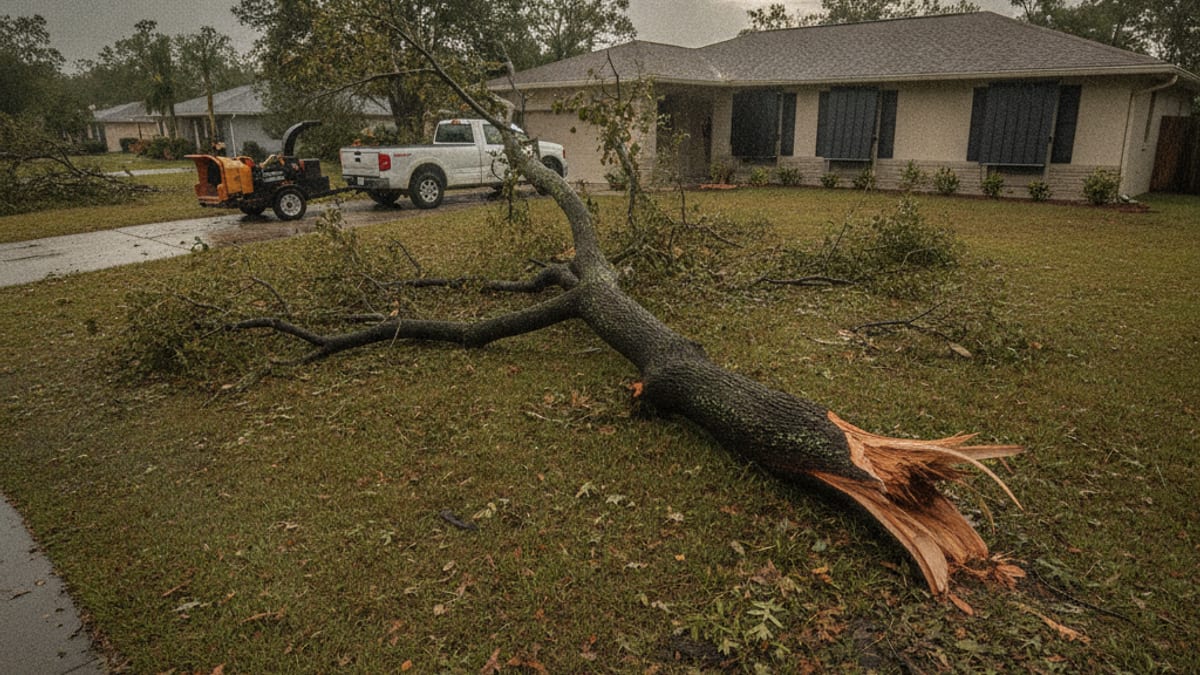
Every June, Tampa Bay does the same dance: watch the tropics, half-joke about the last close call, and quietly hope the season passes without a direct hit. The trees in your yard don’t get a vote in that hope. A live oak that’s been fine for fifteen years can become the thing that punches a hole in your roof if it’s carrying deadwood or a compromised root plate when 60 mile an hour gusts show up.
The good news is that most hurricane tree damage in this region is predictable and preventable if you look at the right things before a storm is named, not after. Here’s the walkthrough worth doing every year in late spring, before hurricane season officially opens on June 1.
Walk the property and look up first
Start with a slow lap around the house and look at the canopy of every tree that could reach the structure if it fell. You’re looking for a handful of specific things: large dead branches (deadwood) hanging in the canopy, especially anything positioned over the roof, driveway, or where cars park; branches rubbing against the roofline or gutters, which weaken both the tree and the roofing over time; and any limb with a visible crack or split, even a partial one, since those are the branches most likely to snap first in sustained wind.
Deadwood is the single easiest hurricane risk to remove before a storm, because it’s already disconnected from the tree’s living structure and just needs to come down. A round of tree trimming in late spring that clears deadwood and reduces canopy density does more for your storm risk than almost anything else on this list, and it’s routine maintenance rather than emergency work, which usually means a lower price and a schedule you control.
Check the base and root flare for warning signs
Wind doesn’t usually snap a healthy trunk. It tips over a tree whose root system is already compromised. Walk to the base of each large tree and look for soil that’s cracked, lifted, or mounded on one side, mushroom-like fungal growth (conks) at the trunk base, and any lean that looks new or more pronounced than it used to be. These are all signs the root plate may already be partially failed, which means the tree is a candidate to go over in a storm regardless of how full and healthy the canopy looks.
Ganoderma root rot shows up often on mature oaks around Tampa, St. Petersburg, and Brandon, and it can weaken a root system for years before the canopy shows obvious decline. If you see conks at the base of any tree near your home, that’s worth a professional look well before storm season, not during it.
Know which species on your property carry more risk
Not every tree fails the same way in a hurricane. Slash pines and other tall, straight-trunked pines are prone to snapping at the trunk in sustained high wind, sometimes with very little visible warning beforehand. Live oaks are generally strong and wind-resistant when healthy, which is part of why they’re such a common street and yard tree throughout the region, but a live oak with existing decay or root damage loses that advantage fast. Laurel oaks and water oaks, being faster growing and shorter lived, are more prone to interior decay and branch failure even without an obvious storm trigger, and that risk compounds when wind gets involved.
If you’ve got a stand of mature pines close to the house, or an older laurel oak that’s looking rough, those are the trees to prioritize for a pre-season evaluation over anything younger or more structurally sound.
Clear the ground-level hazards too
Storm prep isn’t only about what’s overhead. Palms, particularly sabal palms and queen palms, drop fronds naturally, and dead fronds that have been left hanging become wind-driven debris the moment gusts pick up. Trim dead and dying fronds off palms near the house, the driveway, and anywhere vehicles are parked. Palm tree service crews handle this differently than hardwood pruning, since improper frond removal (cutting too close, or removing green fronds that still feed the tree) can actually weaken a palm rather than help it.
Also take stock of anything on the ground that wind could turn into a projectile: dead branches you’ve been meaning to haul off, loose yard debris, and anything stacked near a tree that could get airborne and cause its own damage separate from the tree itself.
If a tree is already a clear hazard, don’t wait for a forecast
If you spot a lean that’s new, a large crack in a major limb or the trunk, or a tree that’s already partially uprooted, that’s not a wait-and-see situation regardless of what the tropics look like that week. A tree in that condition can fail in an ordinary summer thunderstorm just as easily as a hurricane. Getting it addressed in June, when crews have normal scheduling availability, is a very different experience than trying to get someone out during a storm watch when every crew in Hillsborough, Pinellas, and Pasco county is booked solid.
If removal turns out to be the right call, our guide on when to remove versus save a tree can help you understand what a professional will be looking for during that evaluation.
Document your trees before the season, not during a claim
Take dated photos of the large trees on your property, especially ones close enough to the house to cause damage if they fell, before hurricane season ramps up. If a limb or a whole tree does come down during a storm and you end up filing a homeowners insurance claim for roof or fence damage, having a clear record of the tree’s condition beforehand, along with any receipts from prior trimming or removal work, makes the claims process considerably smoother. Insurers generally distinguish between damage from a healthy tree that a storm brought down and damage from a tree that was already visibly hazardous and neglected, so documentation protects you either way.
Line up a crew before the season, not during a watch
The single most avoidable mistake homeowners make with hurricane tree prep is waiting until a storm is already tracking toward Florida to start calling around. Once a system enters the Gulf, every reputable crew in Hillsborough, Pinellas, and Pasco county gets flooded with calls, and legitimate companies get booked out fast, sometimes leaving only unlicensed storm chasers with availability. Getting your trees evaluated and any needed trimming scheduled in April, May, or early June, well ahead of peak season, means you’re working with your normal local company on a normal schedule, at normal pricing, rather than competing for whoever’s left once a watch is issued.
After the storm passes
If a named storm does come through and you’re left with downed limbs, a leaning tree, or a trunk that’s cracked but still standing, resist the urge to deal with it yourself, especially if it’s near power lines or resting against the house. Storm-stressed trees can be under tension in ways that aren’t obvious, and cutting into the wrong spot can release that tension violently. Emergency tree service crews are trained to read that kind of load before they make the first cut, which matters more than speed in the days right after a storm. Lightning leaves a different signature from wind, and a tree struck by lightning needs a different call than a wind-damaged one, especially if it’s a palm.
New construction lots carry their own risk
Homes in newer master-planned communities around Wesley Chapel, Riverview, and parts of Pasco County often have young, recently planted trees, which feels like it should mean less storm risk. In some ways it does, since young trees have less mass to do damage if they do fail. But newly planted trees also have shallow, undeveloped root systems that haven’t had time to anchor firmly, which can make them more prone to being blown over entirely, roots and all, in sustained wind even though a mature tree nearby with a deeper root system stays put. Staking newly planted trees properly for their first one to two years, and checking that stakes and ties haven’t girdled the trunk as it’s grown, is a smaller but real part of storm prep on a newer property.
What a professional walkthrough actually adds
A homeowner can catch a lot of this checklist on their own with a careful look around the yard. What’s harder to self-diagnose is internal decay that hasn’t yet produced visible fungal growth, root damage from nearby construction or grade changes that happened before you owned the property, or a lean that’s subtle enough not to be obviously alarming but is still outside the range of normal growth for that species. A trained arborist walking the same property will often flag two or three things a homeowner walked past without a second thought, simply because they’ve seen what those specific warning signs led to on other properties across the bay.
Building the habit
The homeowners who come through hurricane season with the least tree damage aren’t the ones with the newest trees or the biggest budgets. They’re the ones who walk their property every spring and deal with deadwood, root issues, and structural problems while it’s routine maintenance instead of an emergency. Building that walk into your yearly routine, ideally in April or May before the season officially opens, is the single highest-value thing you can do.
Waterfront properties have one more item on the list, because the mangroves along a seawall are protected by state law and can’t be cut back the way a hedge can. Our guide to mangrove trimming rules in Tampa Bay covers the height limits and which agency approves the work.
If you’d rather have a trained eye do the walkthrough for you, we can connect you with a local ISA-certified arborist for a pre-season inspection, and get any needed trimming scheduled before the first system starts spinning up in the Gulf.