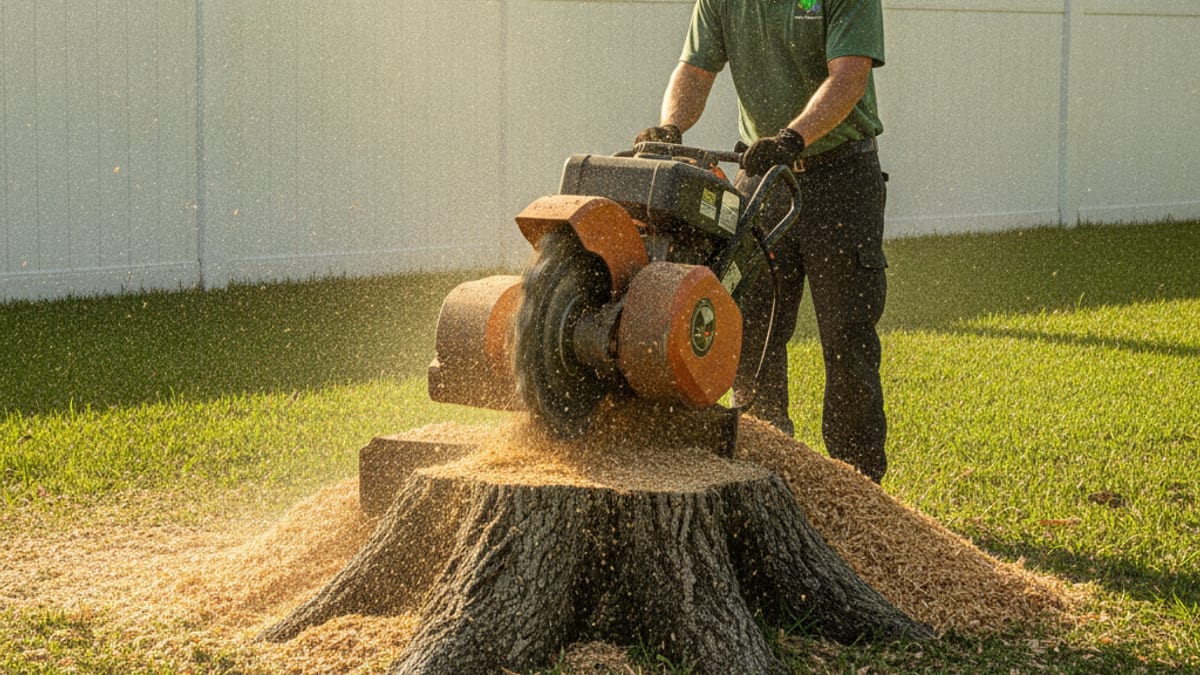
The tree is gone. What’s left in your yard is a flat, splintered disc of wood at ground level, roots spreading out underneath it like veins. Now you’re staring at two options with names that sound almost identical, and a crew that’s asking which one you want before they quote the job. Grinding and removal are not the same service, they don’t cost the same, and picking the wrong one means either paying for work you didn’t need or living with a problem you thought you’d solved.
What stump grinding actually does
Grinding uses a machine with a rotating cutting wheel to chew the visible stump down below the soil line, usually 4 to 6 inches deep, sometimes deeper if you’re planning to replant in that spot. What you’re left with is a pile of wood chips and a shallow depression where the stump used to be. The roots stay in the ground. They’re not pulled out, not dug up, just left to decompose naturally over the coming years.
This is the faster, less invasive option, and it’s what most Tampa Bay homeowners actually need. A grinding job on a mid-size stump typically takes under an hour once the crew is set up, versus a half day or more for full removal. It also does far less damage to the surrounding yard, since there’s no excavation involved. If you’ve got sod, irrigation lines, or a paver patio near the stump, grinding is almost always the safer call.
What stump removal actually does
Removal is a bigger job. It means digging out the entire root ball, not just the visible stump, using an excavator or a stump-pulling attachment depending on the tree’s size and how deep and wide the roots have spread. What’s left behind isn’t a wood-chip-filled depression, it’s a hole, sometimes a substantial one, that needs to be backfilled with soil before you can do anything with the space.
Removal disturbs a lot more ground. Roots from a mature oak or pine can extend well past the trunk’s drip line, and pulling them all out means tearing up grass, potentially hitting irrigation lines or utility conduit, and leaving a footprint that needs regrading. It’s the right call when you actually need that ground clear, not just tidy.
When grinding is the right call
If your goal is a yard that looks finished and mowable, grinding solves the problem. The stump disappears below grade, grass can be seeded or sodded right over the chip layer once it settles, and you’re not paying for excavation you don’t need. This covers the majority of residential jobs across Tampa, Wesley Chapel, and Riverview, where the stump is a cosmetic or tripping-hazard problem rather than a construction obstacle.
Grinding also makes sense when the roots aren’t in the way of anything. Florida’s sandy soil means most residential tree roots stay relatively shallow and spread wide rather than deep, and if there’s no pool deck, foundation, or new planting bed going in on top of that root system, there’s no functional reason to dig it all out.
When removal is actually necessary
Full removal earns its higher cost in a specific set of situations. If you’re planning to build in that exact footprint, a deck, a shed, a pool, or an addition, leftover roots underground can shift, settle, or interfere with the new structure years later. If you’re planting a new tree in the same spot, old roots and residual chemicals from decomposing wood can stunt the new tree’s growth for the first several seasons. And if the original tree had a disease like laurel wilt or ganoderma butt rot, leaving infected root material in the ground can pose a lingering risk to any tree you plant nearby afterward, since some root-borne pathogens persist in soil for years.
Removal is also the better move if the roots have already started lifting a driveway, cracking a foundation edge, or invading a buried sewer pipe. Grinding the visible stump doesn’t stop root growth underground, since the roots you can’t see keep growing until they’re physically taken out or the whole root system finally dies off on its own, which can take considerably longer than most homeowners expect.
The cost difference, and why it’s not small
Grinding is priced mostly by stump diameter and is a same-day job in most cases, with pricing that scales predictably as trunk size increases. Removal costs considerably more because it’s excavation work: heavier equipment, more labor hours, disposal of a much larger volume of root material, and usually backfill and regrading afterward. For a single mid-size stump in a typical Tampa Bay backyard, expect removal to run several times what grinding costs for the same tree. That gap widens fast for large oaks or pines with extensive root systems.
Get both options quoted before you decide. A crew that’s actually looked at your yard, the stump’s location, the soil, and what you’re planning to do with the space afterward can tell you honestly whether you’re paying for excavation you don’t need.
What about the leftover wood chips
Grinding produces a substantial pile of chips, often more than homeowners expect from a single stump. Some Tampa Bay companies haul the debris away as part of the job, others leave it for you to spread as mulch or have hauled separately. Ask which is included before the crew shows up, since disposal fees can be a surprise add-on if it’s not covered in the original quote.
How the original tree’s root type changes the math
Not all Tampa Bay trees leave the same kind of root system behind, and that affects which option makes more sense. Slash pines and other conifers tend to develop a deeper taproot along with lateral roots, which can mean removal digs deeper and disturbs a narrower footprint. Live oaks and laurel oaks, by contrast, spread wide, shallow, lateral root systems that can extend well beyond the canopy’s drip line, so full removal on a mature oak often means excavating a much larger area of yard than homeowners expect going in, sometimes disrupting turf and beds far from the original trunk location.
This is worth asking about specifically when you’re getting quotes. A crew that’s assessed the tree species and root pattern, not just the visible stump diameter, can give you a more accurate picture of how much yard disruption removal would actually involve, and whether grinding might get you 90 percent of the benefit for a fraction of the mess.
Timing: how soon after removal should you decide
You don’t have to make the grinding-versus-removal call the same day the tree comes down, though doing the work together with the original removal often saves a second trip charge and a second mobilization fee. If you’re not sure yet what you want to do with the space, it’s reasonable to have the tree removed, leave the stump in place temporarily, and make the grinding or removal decision once you’ve had time to think through your plans for that part of the yard.
That said, stumps left untreated for extended periods can attract wood-boring insects and become a host site for fungal decay that can spread to nearby healthy trees, particularly if the original tree came down due to disease rather than storm damage or age. If disease was the reason for removal, it’s worth addressing the stump sooner rather than later, and specifically discussing with your crew whether grinding alone adequately reduces that spread risk or whether removal is the safer call given what killed the original tree.
Making the decision for your yard
Start by asking what you actually plan to do with that spot. If the answer is “nothing, I just want the yard to look normal again,” grinding is almost certainly your answer, and it’s the faster, cheaper path to get there. If the answer involves construction, planting, or a root system that’s already causing damage nearby, removal is worth the extra cost because grinding won’t solve the underlying problem.
If you’re not sure which category your situation falls into, that’s a reasonable thing to ask a crew directly before scheduling anything. A quick look at the stump, the surrounding hardscape, and what’s planned for the space is usually enough for an experienced tree removal crew to steer you toward the right service instead of the more expensive default. And if the original tree came down because of storm damage or disease, pairing that removal with a stump grinding quote up front, rather than scheduling it as a separate job later, usually saves a second site visit and a second trip charge.