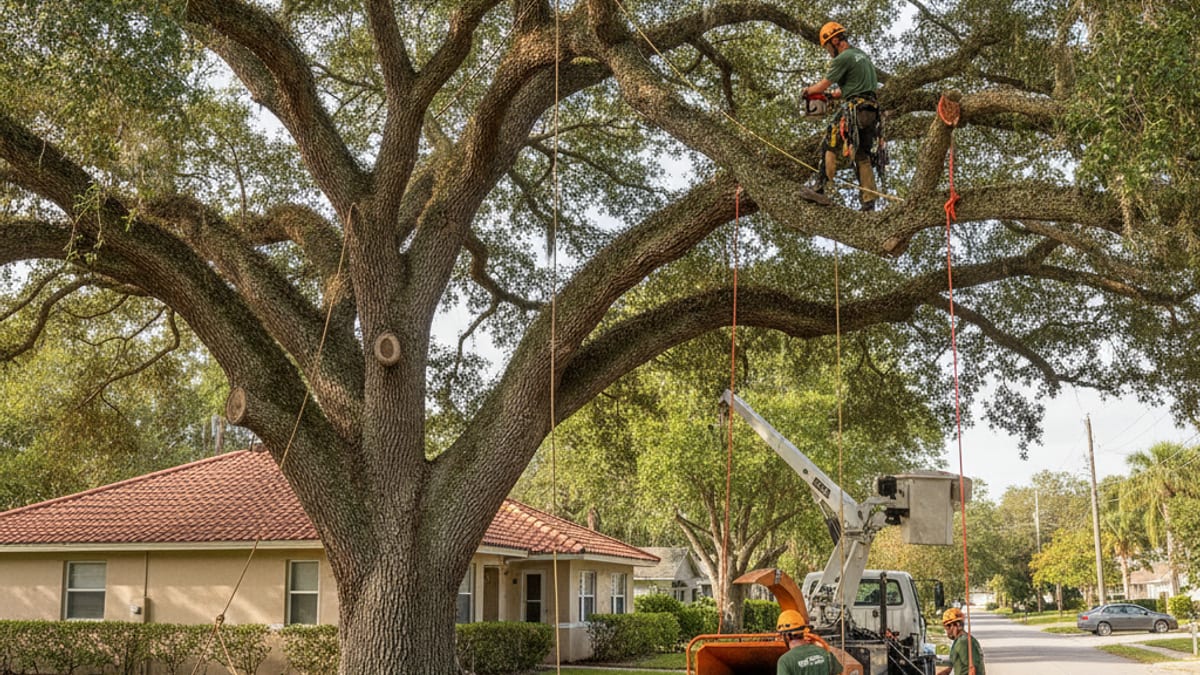
“It’s my property” is the first thing most homeowners say when they find out a tree in their own yard might need government sign off before it comes down. It’s a fair reaction, and also not quite how it works in most of Tampa Bay. Cities and counties across Hillsborough, Pinellas, and Pasco protect certain trees, usually based on species and trunk diameter, and cutting a protected tree without the right documentation can mean fines that cost more than the removal itself.
The rules aren’t uniform across the region, which is exactly why this trips people up. What’s required in the City of Tampa isn’t the same as unincorporated Hillsborough County, and Pinellas municipalities each set their own thresholds too. Here’s how to figure out where your tree actually stands.
Why some trees are protected and others aren’t
Local tree ordinances almost always target the trees that provide the most shade, habitat, and stormwater benefit, which usually means large, mature specimens of certain species rather than every tree on a lot. Live oaks, in particular, show up on protected species lists across most Tampa Bay jurisdictions because of how much canopy and root structure a mature specimen represents, sometimes a century or more of growth that can’t be replaced on any practical timeline.
Ordinances typically set a minimum trunk diameter, measured at a standard height on the trunk (often called diameter at breast height, or DBH), below which a tree isn’t regulated at all. A young oak well under that threshold usually doesn’t need a permit. A grand oak that’s been standing since before the neighborhood was platted almost certainly does, if it’s a protected species in your jurisdiction.
What generally requires a permit
Across most of Tampa Bay’s cities and counties, you’re likely to need a permit before removing:
- Live oaks and other protected species above the local diameter threshold, which varies by jurisdiction, often somewhere in the range of 4 to 8 inches DBH for a hardwood to be regulated at all.
- Any tree designated a “specimen” or “grand” tree by size, a status some jurisdictions apply automatically once a tree crosses a larger diameter threshold, sometimes triggering stricter replacement requirements.
- Trees in a right of way, easement, or any area the city or county maintains, even if it’s within your fence line.
- Trees on commercial or multi-family properties, which are frequently subject to stricter landscaping and tree preservation codes than single-family residential lots.
What generally does not require a permit
Most jurisdictions exempt certain situations from the permit process entirely:
- Trees below the minimum diameter threshold for regulated species.
- Non-native or invasive species that many local ordinances specifically exclude from protection, such as Brazilian pepper, camphor tree, or Chinese tallow.
- Dead, dying, or hazardous trees, under Florida law, though this exemption comes with an important documentation requirement covered below.
- Routine tree trimming and pruning that doesn’t remove the tree entirely, though some jurisdictions do regulate how much canopy can be removed at once from a protected tree.
The Florida dangerous tree exemption
Florida state law (Section 163.045, Florida Statutes) limits how much local governments can require for removing a tree that’s dead, dying, or presents a danger to people or property on residential property, regardless of local ordinances. The homeowner generally needs documentation from a certified arborist or a Florida licensed landscape architect confirming the tree’s condition, but once that documentation exists, local governments largely cannot require an additional permit or mitigation for that specific removal.
This exemption has real limits worth understanding before you rely on it. It applies to trees on residential property, and it requires actual, credible documentation of the hazard, not just a homeowner’s opinion that a tree looks risky. It’s also not a loophole for removing a healthy tree you simply don’t want anymore. A qualified arborist consultation that documents genuine hazard conditions, root or trunk decay, significant lean, structural failure, is the right way to use this provision if your tree genuinely qualifies.
How to actually check your specific property
Because rules vary by jurisdiction and change periodically, the reliable way to find out what applies to your tree is to contact the office directly rather than relying on a general guide like this one:
- City of Tampa properties fall under the city’s Urban Forestry program, which maintains the tree protection ordinance and permit process for city limits.
- Unincorporated Hillsborough County properties, including many of the newer developments in Riverview, Brandon, and areas outside city limits, fall under the county’s own landscape and tree protection code.
- Pinellas County municipalities, including St. Petersburg, Clearwater, and Largo, each maintain their own tree ordinances separate from unincorporated Pinellas County, so which set of rules applies depends on the specific address.
- Pasco County and its municipalities, including New Port Richey and Wesley Chapel’s unincorporated areas, similarly split jurisdiction between the county and individual cities.
A quick call to your city or county’s planning, zoning, or urban forestry department, with your address ready, will tell you definitively whether a specific tree is regulated and what documentation, if any, a permit application requires.
Multi-tree and land clearing projects follow different rules
If you’re not removing a single tree but clearing several, whether it’s preparing a wooded lot for construction, opening up an overgrown back acreage in Pasco County, or removing a line of declining trees along a property boundary, the permitting process typically shifts from a single-tree removal permit to a land clearing or site development review, especially on larger parcels. These reviews often look at stormwater management, tree canopy preservation ratios across the whole site, and sometimes require a licensed surveyor or engineer’s input in addition to arborist documentation. If you’re planning any kind of land clearing project, it’s worth involving your local planning department early, since the scope of review is usually larger than a homeowner expects for what feels like a straightforward job.
What to gather before you apply
Most permit applications move faster when you show up with the right documentation already in hand rather than starting from scratch at the counter. That typically means the tree’s approximate trunk diameter at breast height, its species if you can identify it, its location relative to your property lines and any structures, and, if you’re claiming the tree is dead, dying, or hazardous, written documentation from a certified arborist supporting that assessment. Some jurisdictions also want photos of the tree from multiple angles submitted with the application. Having all of this ready before your first call to the permitting office typically shaves real time off the process, especially in busier permitting seasons after a storm has come through and generated a backlog of applications from other homeowners in the same situation.
What happens if you skip the permit
Removing a protected tree without the required permit can result in fines that are frequently structured per tree and per inch of trunk diameter, which on a single mature live oak can add up to a meaningful amount, sometimes well beyond what the removal itself would have cost. Some jurisdictions also require mitigation, meaning replacement trees planted at a ratio set by the ordinance, on top of any fine. Given that gap, confirming permit status before removal is almost always cheaper than finding out after the fact.
HOA rules can be stricter than the city or county
Even if a tree isn’t regulated by your local government, it might still be governed by your homeowners association’s covenants, which can add a separate layer of approval on top of, or sometimes independent from, municipal rules. Some Tampa Bay HOAs, particularly in newer planned communities around Wesley Chapel and parts of Riverview, require board approval before removing any tree over a certain size, regardless of species, as part of maintaining a consistent neighborhood landscape standard. Skipping that step can mean a fine from the HOA even when the removal was perfectly legal from the city or county’s perspective. If you’re in a deed-restricted community, it’s worth checking your HOA’s architectural review or landscaping guidelines alongside, not instead of, your municipal permit research.
Why this trips up so many homeowners
Most people don’t think about permits until they’re already mid-project, usually because a tree suddenly looks dangerous, a storm just came through, or a landscaping project is underway and a tree happens to be in the way. Tree ordinances, unlike a lot of permitting rules, aren’t always posted prominently, and the diameter thresholds and protected species lists genuinely do vary enough between neighboring jurisdictions, say, unincorporated Hillsborough County versus the City of Tampa, that even homeowners who’ve lived in the area for years can be caught off guard by a rule that’s different from what a friend across town described to them. Building the permit check into your planning from the start, rather than treating it as a formality to confirm after you’ve already scheduled the crew, avoids the scenario where a removal has to be paused mid-project while paperwork catches up.
Getting it handled correctly
Mangroves are a separate regime entirely, run under state law rather than a city or county tree ordinance, and our guide to mangrove trimming rules in Tampa Bay covers who has jurisdiction over a waterfront shoreline.
If you’re not sure whether your tree needs a permit, that uncertainty is worth resolving before a crew shows up with a chainsaw. We can connect you with a local, insured crew and an ISA-certified arborist who can evaluate your specific tree, tell you honestly whether it’s likely to be regulated, and help you understand what documentation, if any, the removal will require in your city or county.