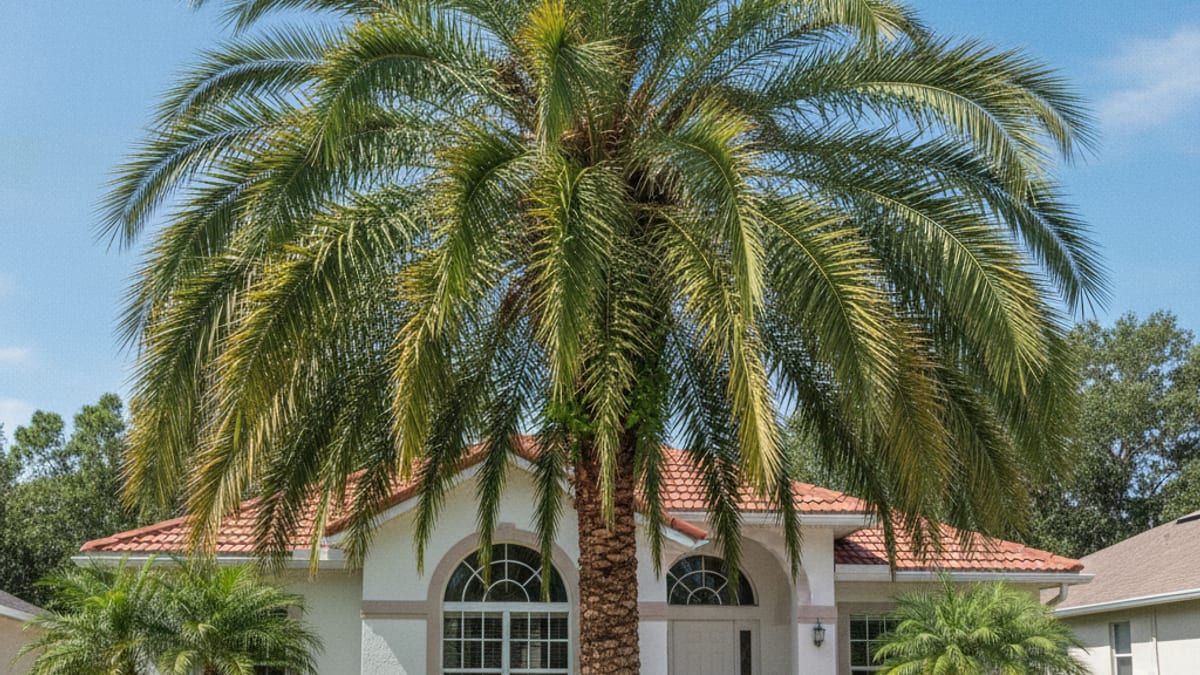
Palm trees look like they need constant grooming. Brown fronds droop, seed pods hang heavy, and the whole tree seems to invite a trim every time a landscaping crew shows up. That instinct is exactly what causes the most common palm health problem in Tampa Bay: over-pruning. Palms aren’t oaks. They grow, heal, and store nutrients differently, and the trimming schedule that keeps a live oak looking sharp will slowly starve a palm if you apply it here.
Why palm trimming schedules are different
A palm tree has a single growing point at the top, called the bud or the crown, and it draws stored nutrients and water from its fronds, including the older, lower ones that look ready to cut. Unlike a hardwood tree, a palm can’t grow new branches to replace what’s removed. Every frond it has is either actively feeding the tree or slowly finishing that job as it yellows and browns. Cut too many green or yellowing fronds at once and you’re not tidying the tree, you’re cutting off its nutrient supply mid-cycle.
This is why most arborists who actually specialize in palms recommend trimming far less often than general landscaping crews suggest. A palm doesn’t need to look manicured to be healthy. In fact, a palm that always looks perfectly clean is often one that’s being over-trimmed on a schedule that’s hurting it long term.
The real trimming schedule for Tampa Bay palms
For most sabal palms, queen palms, and Canary Island date palms common across Hillsborough and Pinellas counties, one to two trims per year covers what the tree actually needs. That’s it. Once in late spring before hurricane season ramps up, and again in late fall if the tree has produced a lot of new brown growth, is a reasonable cadence for most residential palms.
The goal each time should be removing only fronds that are fully brown or dead, plus any seed pods if you want to reduce mess and prevent volunteer seedlings sprouting in your beds. Fronds that are still partly green, even mostly yellow with some green remaining, are still doing work for the tree and shouldn’t come off yet.
What “hurricane cuts” get wrong
Ask around Tampa Bay and you’ll hear the term “hurricane cut,” a heavy trim that strips a palm down to just a handful of upright fronds around the crown, leaving the tree looking like a feather duster. It’s marketed as storm prep, and it’s one of the worst things you can do to a palm’s long-term health.
Removing that much live canopy doesn’t make the tree meaningfully more storm-resistant. What it does is strip away the fronds the palm needs to photosynthesize and store energy, weaken the crown’s structural integrity over time, and in some cases expose the bud to sun and pest damage it wasn’t built to handle unprotected. Palms that get hurricane cuts repeatedly tend to show stunted new growth, a narrower canopy each year, and increased vulnerability to pests and disease, the opposite of what the trim was supposed to accomplish.
If storm prep is the actual goal, the better approach is removing only dead or clearly weak fronds and any loose seed pods that could become wind-driven debris, not stripping the whole crown. A storm prep assessment before hurricane season can identify which of your trees, palms included, actually pose a wind risk without resorting to over-pruning healthy growth.
Signs your palm is being trimmed too often
If a landscaping crew is trimming your palms every time they mow, or every single visit includes “cleaning up” the canopy, that’s too frequent. Watch for a canopy that never has more than 6 to 8 fronds at any point, new fronds coming in noticeably smaller or more yellow than in past seasons, and a crown that looks thin or lopsided rather than full and round. These are signs the tree is being cut faster than it can replace what it’s losing.
Over time, chronically over-trimmed palms show slower growth, reduced resistance to cold snaps and drought stress, and a higher susceptibility to pests like palm weevils, which are drawn to stressed trees. What starts as a cosmetic habit can turn into a tree health problem that takes years to reverse, if it reverses at all.
What a proper trim actually looks like
A well-trimmed sabal or queen palm should keep a full, rounded canopy, roughly a 9 to 3 o’clock silhouette when you look at the crown from the side, meaning fronds extending outward and slightly down, not just a tight tuft pointing straight up. Only fully brown, dead, or clearly hazardous fronds get removed. Green and yellow-green fronds stay, even if they don’t look tidy.
Clean, sharp tools matter here too, since ragged cuts create larger wound surfaces that take longer to seal and give pests and fungal spores more opportunity to get in. This is part of why hiring a crew that actually knows palm biology, not just general tree trimming technique, makes a real difference in how your palms hold up over years, not just how they look the week after a trim.
What about disease risk from over-pruning
There’s a health angle beyond nutrient loss. Lethal bronzing, a phytoplasma disease that has spread through sabal and other palm species across Florida, and various fungal issues can enter a palm through fresh pruning wounds, especially when tools aren’t sanitized between trees. A palm that’s trimmed too frequently gets more open wounds per year, which means more opportunities for infection. Less frequent, properly timed trims, done with clean tools, reduce that exposure window significantly.
If you’re noticing frond discoloration that doesn’t look like normal aging, yellowing that starts at the tips and works inward, or a canopy that’s thinning despite recent trims, that’s worth a professional look rather than another round of pruning. Sometimes what looks like a trimming problem is actually an early tree health issue that pruning alone won’t fix.
Why DIY palm trimming carries more risk than it looks like
A lot of Tampa Bay homeowners trim their own palms, and for low, easily reached trees that’s often manageable. The risk climbs fast once a palm’s crown is more than a story or two off the ground, which is common for mature sabals and Canary Island date palms across older neighborhoods. Working from a ladder against a curved, often unstable palm trunk is a different challenge than ladder work against a flat wall, and falls from palm trimming are a recurring cause of serious injury during the spring and fall trimming season.
There’s also a tool-hygiene risk that’s easy to overlook. Pruning saws and blades that go from tree to tree without being cleaned or sanitized between cuts can spread fungal spores and disease pathogens, including some of the same issues that cause lethal bronzing and ganoderma butt rot. A homeowner trimming one or two palms in their own yard has less exposure to this than a crew moving between multiple properties, but it’s still worth wiping blades down with a disinfectant between cuts on different trees, especially if any tree on the property has shown signs of disease.
What about coconut palms and other less common species
Tampa Bay sits close enough to the edge of coconut palm cold tolerance that the species shows up in yards here, though less reliably than in South Florida. Coconut palms follow the same general trimming principle as sabals and queens, remove only fully brown fronds and avoid stripping green canopy, but they carry an added consideration: mature coconut palms drop heavy fruit that can pose a real hazard if the tree overhangs a driveway, walkway, or parking area. Removing coconuts before they mature and fall is a reasonable safety practice that doesn’t count as canopy trimming and can be done more frequently without harming the tree.
Other less common Tampa Bay palms, like the Chinese fan palm or Mexican fan palm, generally follow the same low-frequency trimming guidance as sabals. If you’re not sure which species you’re dealing with or how it should be handled differently from what’s described here, it’s worth getting a straight answer before assuming a generic palm-care routine applies.
The bottom line
The same over-trimming instinct causes bigger problems on the water. Mangroves along a Tampa Bay shoreline are protected, and our guide to mangrove trimming rules in Tampa Bay explains the height floor that can never be crossed.
Your palms don’t need the same attention your lawn does. One or two thoughtful trims a year, focused only on dead and hazardous fronds, keeps a Tampa Bay palm healthier and more storm-resilient than an aggressive quarterly schedule ever will. If a crew is pushing more frequent trims than that, or recommending a hurricane cut as routine maintenance, it’s worth getting a second opinion before they touch the tree again.