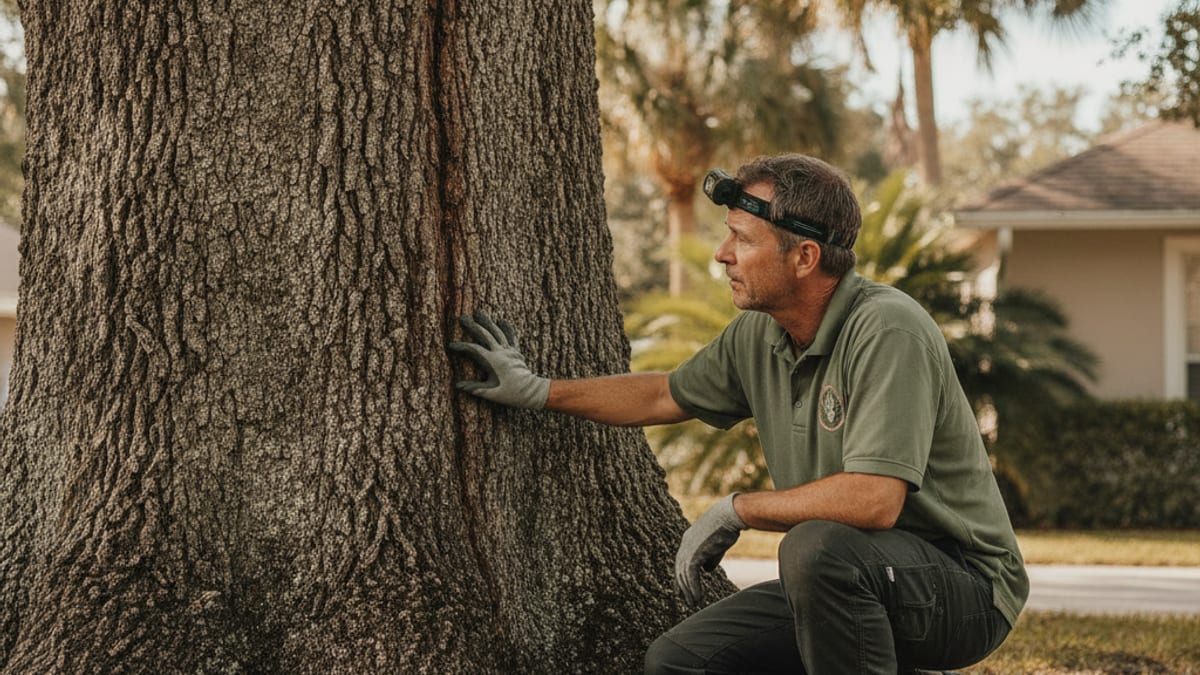
Half the calls we hear about start the same way: a tree looks bad and the homeowner assumes it has to go. Sometimes that’s right. A lot of the time, though, a tree that looks alarming is actually fine, and a tree that looks fine is quietly failing underneath. The difference matters, because removal is permanent and a mature live oak or bald cypress took decades to grow the shade you’re standing under.
Here’s the actual framework arborists use to make that call, so you can walk into an estimate already knowing roughly what you’re dealing with.
Start with the root flare, not the canopy
Most homeowners look up first. Arborists look down. The base of the trunk, where it widens into the root flare, tells you more about a tree’s stability than anything happening in the leaves. Look for mushrooms or shelf-like fungal growth (conks) at the base, soil that’s cracked or lifted on one side, or a trunk that flares unevenly. Any of these can point to root rot or a root plate that’s already partially failed, which means the tree could go over in the next strong wind regardless of how healthy the canopy looks.
Ganoderma root rot is common on oaks throughout Hillsborough and Pinellas county and often shows up as those shelf fungi at the base years before the canopy shows any real decline. By the time the leaves thin out, the internal damage is usually extensive. If you see conks at the base of a tree, that’s a strong signal to get an arborist consultation before you do anything else, including nothing.
A dead tree is not automatically a removal
A completely dead tree standing well away from the house, a fence line, or where people walk isn’t automatically a hazard. Snags provide habitat, and if a dead pine is 40 feet from the nearest structure with a clear fall radius, some homeowners choose to leave it standing rather than pay for removal they don’t strictly need. The calculation changes fast, though, once there’s a target in range: a roof, a car, a power line, a play area, or a neighbor’s fence. And when the tree in question is the neighbor’s, our guide to overhanging tree branches in Florida explains what you can legally trim yourself.
The real question isn’t “is it dead,” it’s “what does it hit if it falls, and how soon might that happen.” A standing dead pine can hold for years or drop a limb next week. That unpredictability is exactly why leaning dead trees near structures get prioritized over healthy ones that just look messy.
A lean by itself doesn’t mean removal
New leans and old leans read very differently to a trained eye. A tree that’s grown at an angle its whole life, reaching for sunlight around a neighboring structure, has usually developed reaction wood and root structure to support that lean permanently. It looks dramatic but it’s stable.
A tree that leans further than it used to, especially after a storm, or one where you can see soil heaving or cracking on the side opposite the lean, is a different story entirely. That’s often a sign the root plate is lifting, and it means the tree could be actively failing rather than simply growing at an angle. If you’ve noticed a lean that’s new or getting worse, don’t wait on it. That’s a same-week call, not a someday call.
Species matters for how much benefit of the doubt to give
Not every species ages the same way in Tampa Bay’s heat and humidity. Live oaks are famously long-lived and structurally strong, and a mature specimen is worth real effort to save through pruning and cabling if it develops a manageable problem. Laurel oaks and water oaks are a different case. They’re fast growing and short-lived by comparison, commonly reaching structural decline by 40 to 50 years old, and they’re especially prone to interior decay that doesn’t always show from the outside. A laurel oak with any combination of dead wood, fungal conks, and included bark at a major branch union is a much weaker candidate for saving than a live oak showing the same symptoms.
Pines bring their own risk profile. Slash pine and longleaf pine can fail suddenly at the trunk during high wind events, sometimes with little visible warning, which is part of why standing dead pines near homes get flagged quickly. If laurel oaks are what you’re staring at in your own yard, our guide to laurel oak decline in Tampa Bay covers exactly why this species fails earlier than other oaks and what to watch for.
The included bark problem
Look at where major limbs branch off the trunk. A tight, V-shaped union where bark is pinched between the two branches (called included bark) is structurally weaker than a wide, U-shaped union. Trees with included bark at large branch unions are more prone to splitting, especially in wind, even if the rest of the tree looks perfectly healthy. This is something a professional structural pruning plan can sometimes address early, before it becomes a full limb failure.
What can actually be saved
A lot of trees people assume need removal can be corrected with the right work instead:
- Storm-damaged canopies with broken limbs but an intact trunk and root system usually recover well with proper cleanup pruning.
- Trees crowding a structure or power line often just need selective trimming rather than full removal.
- Early-stage fungal issues, caught before major root or trunk decay, can sometimes be managed with treatment and monitoring.
- Trees weakened by poor prior pruning (topping, over-thinning) can often be corrected over a few seasons of structural pruning rather than removed outright.
A qualified tree health evaluation is the way to find out which category your tree falls into before you commit to removal you might not need.
Cabling and bracing can extend a borderline tree’s life
For a structurally valuable tree with a specific, manageable weakness, like a codominant trunk with included bark or a large limb with a partial crack, arborists sometimes install cabling or bracing systems rather than recommending removal outright. A cable, typically a steel or synthetic support line installed high in the canopy between two major limbs, reduces the stress on a weak union during wind without preventing the tree from moving naturally. Bracing, usually a threaded rod through the trunk or a major limb, provides more rigid support for a specific structural defect.
These systems aren’t a fix for a tree that’s fundamentally unstable at the root, and they don’t turn a hazardous tree into a safe one. What they do well is buy time and add support for an otherwise healthy, structurally valuable tree with one identifiable weak point, often a live oak with sentimental or shade value worth preserving. It’s a conversation worth having during a structural pruning evaluation rather than assuming a defect automatically means removal.
Weigh the real cost of removal against the real cost of saving it
Saving a tree isn’t free. Structural pruning, cabling, root treatment, and ongoing monitoring all cost money over time, sometimes more cumulatively than a single removal would have. For a young or mid-size tree, removal is often genuinely the more economical path if the defect is serious. For a mature, high-value specimen, especially a wide-canopy live oak that took 50 or more years to reach its current size, the shade, cooling, and property value it represents usually justifies spending more to preserve it than a younger, easily replaced tree would warrant. Part of an honest evaluation is being told plainly which category your tree falls into, rather than being upsold on preservation work for a tree that’s already past the point of no return, or pushed toward removal for a tree that had years of life left in it.
What almost never gets saved
Some situations are close to unanimous among arborists. A tree with more than 50 percent of its root system compromised by construction, grade change, or rot has usually lost the structural capacity to stay upright long term, no matter how full the canopy still looks. A trunk with a large open cavity extending more than a third of the way through, especially combined with any lean, is generally considered too weakened to safely retain. And a tree that has already partially uprooted, even slightly, has told you everything you need to know. At that point the decision isn’t really about whether to save it. It’s about how quickly to get it down safely.
Get a second look before you decide
Because the stakes on both sides are real, an unnecessary removal loses decades of shade and root stability, while keeping a genuinely hazardous tree risks your home, a walk-through from someone trained to read root flares, cavities, and lean patterns is worth the time before you sign a removal contract or talk yourself out of one. We can connect you with a local ISA-certified arborist who can look at the specific tree in question and tell you honestly which category it falls into.