Search “laurel wilt” and you’ll land on a lot of pages that lump it in with oak problems, and it’s an easy mix up. The name sounds like it should mean oak disease, laurel oaks are everywhere in Tampa Bay, and plenty of them really are dying. But laurel wilt and laurel oak decline are two different problems with two different causes, and mixing them up leads homeowners to treat the wrong thing or worry about the wrong tree. Here’s what’s actually going on with each.
What laurel wilt actually is
Laurel wilt is a fungal disease caused by a fungus carried by the redbay ambrosia beetle, a tiny invasive insect that showed up in the southeastern United States in the early 2000s. The beetle bores into a tree’s trunk and introduces the fungus as it tunnels, and the fungus then clogs the tree’s water-conducting tissue, causing rapid wilting and death, often within weeks of the first visible symptoms.
The key detail is which trees it targets: laurel wilt specifically attacks members of the plant family Lauraceae. In Florida, that means redbay, swamp bay, and silk bay in the wild, along with sassafras, camphor trees, and commercially, avocado trees. It has devastated redbay populations across the Southeast, including large stands throughout Central Florida, and it’s a serious threat to Florida’s commercial avocado industry.
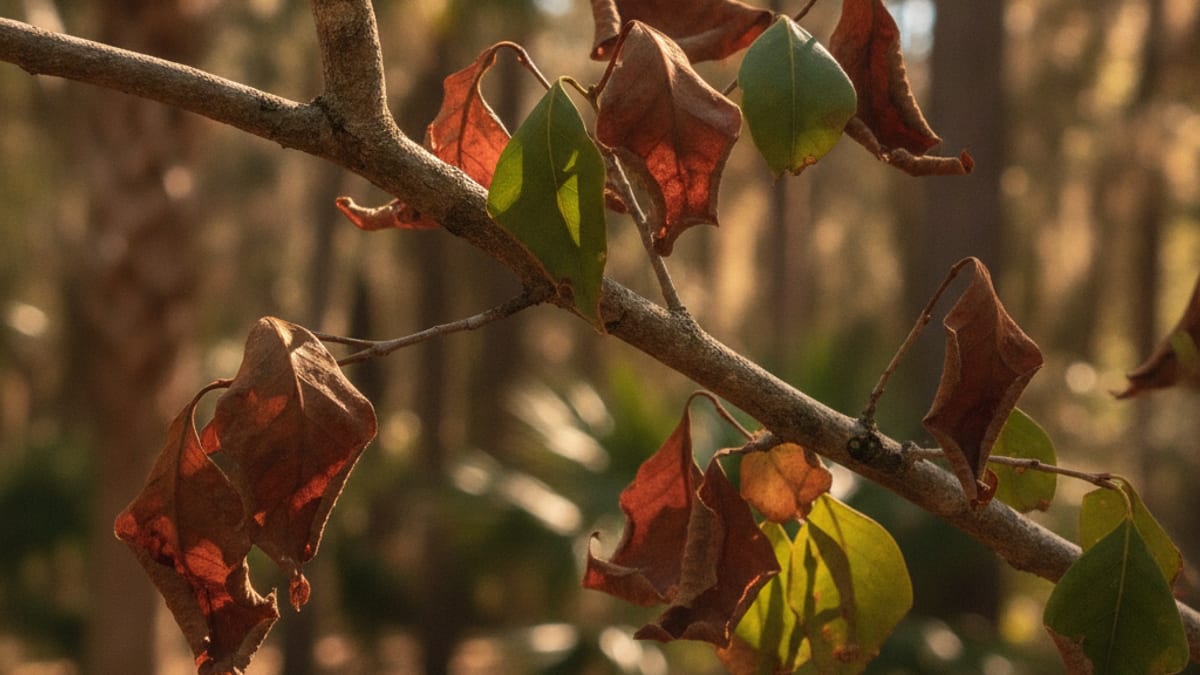
Laurel oaks are not in that family. Despite the name, laurel oak (Quercus laurifolia) is a true oak in the Fagaceae family, botanically unrelated to redbay, sassafras, or avocado. Laurel wilt does not infect laurel oaks, live oaks, water oaks, or any other Florida oak species. If you have a redbay tree, a wild avocado, or a sassafras on your property showing sudden wilting, browning leaves that stay attached to the branch, and dark staining in the wood just under the bark, that’s a laurel wilt profile worth getting checked. If it’s an oak, something else is going on.
What’s actually killing Tampa Bay’s laurel oaks
Laurel oaks have a real reputation problem in this region, and it’s earned, just not because of laurel wilt. They’re one of the fastest growing oaks in Florida, which makes them popular as quick shade trees in newer developments, but that speed comes at a cost. Laurel oaks are notably short-lived compared to live oaks, commonly reaching structural decline by 40 to 50 years old, and they’re especially prone to interior wood decay that doesn’t always show from the outside until the tree is already compromised.
The most common culprit behind a failing laurel oak in Tampa, Brandon, or Riverview is heart rot, caused by fungal organisms like Ganoderma that enter through wounds, old pruning cuts, or storm damage and slowly hollow out the interior of the trunk and major limbs. A laurel oak can carry a full, green canopy right up until the point a large limb, or the whole tree, fails during a wind event, because the decay is happening on the inside while the outside looks fine.
Signs your laurel oak is in decline
- Mushroom-like fungal growth (conks) at the base of the trunk or at old wound sites, a strong sign of Ganoderma root or heart rot.
- Cavities or soft, punky wood you can probe with a screwdriver at pruning wounds or old branch stubs.
- Large dead limbs within an otherwise green canopy, a pattern typical of internal decay rather than a whole-tree issue.
- A trunk that sounds hollow when tapped, or visible cracking along the trunk.
- Excessive epicormic sprouting (small shoots growing directly from the trunk or major limbs), which is often a stress response.
None of these are laurel wilt symptoms. They’re structural decay symptoms, and they call for a different response: not disease treatment, but a decay assessment to determine whether the tree can be pruned and monitored or needs to come down. For a tree showing multiple signs on this list, especially any combination of conks and cavities, a tree health evaluation from a qualified arborist is worth doing before the tree makes the decision for you during a storm.
How laurel wilt actually spreads
Understanding the spread pattern matters if you have any Lauraceae species on your property. The redbay ambrosia beetle is drawn to stressed or recently cut trees, which is part of why moving firewood is such an effective way to accidentally transport the disease. A beetle can be living inside a cut log from an infected redbay, and when that firewood gets moved, even a short distance, and used somewhere else, it can introduce the fungus to a new area entirely. This is why Florida forestry officials have long recommended not transporting firewood across county lines, and it applies just as much to a homeowner cutting up a dead redbay in their own yard as it does to campers.
Once a beetle population establishes itself in an area with a stand of susceptible trees, like a cluster of wild redbay along a creek or wetland edge common throughout Hillsborough and Pasco county, the disease can move through that stand fairly quickly, sometimes killing the majority of redbay in a wooded area within a few years. This is part of why the disease has had such an outsized ecological impact in Florida specifically, since redbay is a foundational understory species in a lot of the state’s natural pine flatwoods and hammocks.
Other real oak problems in Tampa Bay worth knowing
Laurel wilt gets the confused search traffic, but it’s not the only oak-adjacent name that trips people up. Oak wilt, a genuinely different disease caused by a different fungus entirely (Bretziella fagacearum), devastates oaks across parts of the Midwest and Texas but is not currently established in Florida, so it’s not a realistic concern for a Tampa Bay oak despite occasionally coming up in general online searches about oak disease. What Florida oaks actually contend with, beyond the heart rot and Ganoderma root rot already covered above, includes bacterial leaf scorch, a slower decline disease that causes marginal leaf browning and canopy thinning over several years, and oak leaf blister, a cosmetic fungal issue that causes raised, blistered patches on leaves but rarely threatens the tree’s structural health. Neither of these carries the urgency of a decaying, structurally compromised laurel oak, which is why getting an accurate diagnosis from someone who can tell them apart matters more than a quick internet search.
Why the confusion matters practically
If a homeowner assumes their declining laurel oak has laurel wilt, they might look for treatments aimed at the wrong pathogen, or assume there’s nothing to be done because laurel wilt has no reliable cure. Neither is accurate for an oak. Heart rot in an oak is a structural problem that an arborist can actually assess, sometimes catching it early enough to manage with pruning and monitoring, and sometimes confirming the tree has lost too much structural integrity and needs tree removal before it fails on its own schedule.
Getting the diagnosis right also matters for anything else you’re growing nearby. If you’ve got redbay, sassafras, or an avocado tree near a declining laurel oak, don’t assume the oak’s problem is contagious to those species. It isn’t, since they’re different diseases entirely. But if you do have Lauraceae family trees on the property, it’s worth having them checked separately, since laurel wilt spreads efficiently between susceptible species once the beetle finds a stand of them.
What to actually do about each
For a redbay, sassafras, or avocado tree showing sudden wilt: there’s currently no cure for laurel wilt once a tree is infected. The tree will typically die within weeks to a few months. The priority becomes preventing spread, which means not moving firewood from an infected tree to a new area, since the beetle can travel in cut wood, and removing the dead tree before it becomes a beetle breeding site that threatens other Lauraceae trees nearby.
For a laurel oak showing signs of decay: the tree isn’t necessarily a lost cause the way a laurel-wilt-infected redbay is. An arborist can assess how much of the trunk and root system is compromised. Early-stage decay confined to one section sometimes allows for pruning and continued monitoring. Advanced decay, especially combined with a lean or a cavity extending deep into the trunk, usually means removal is the safer call. Our guide on when to remove versus save a tree covers how that decision typically gets made.
Getting it checked
Whether you’ve got a laurel oak that’s worrying you or a redbay showing sudden wilt, the right first step is the same: get eyes on the actual tree from someone who can tell the two problems apart. We can connect you with a local ISA-certified arborist who serves Hillsborough, Pinellas, and Pasco county to evaluate the tree and give you an honest read on what’s actually happening and what it means for the trees around it.