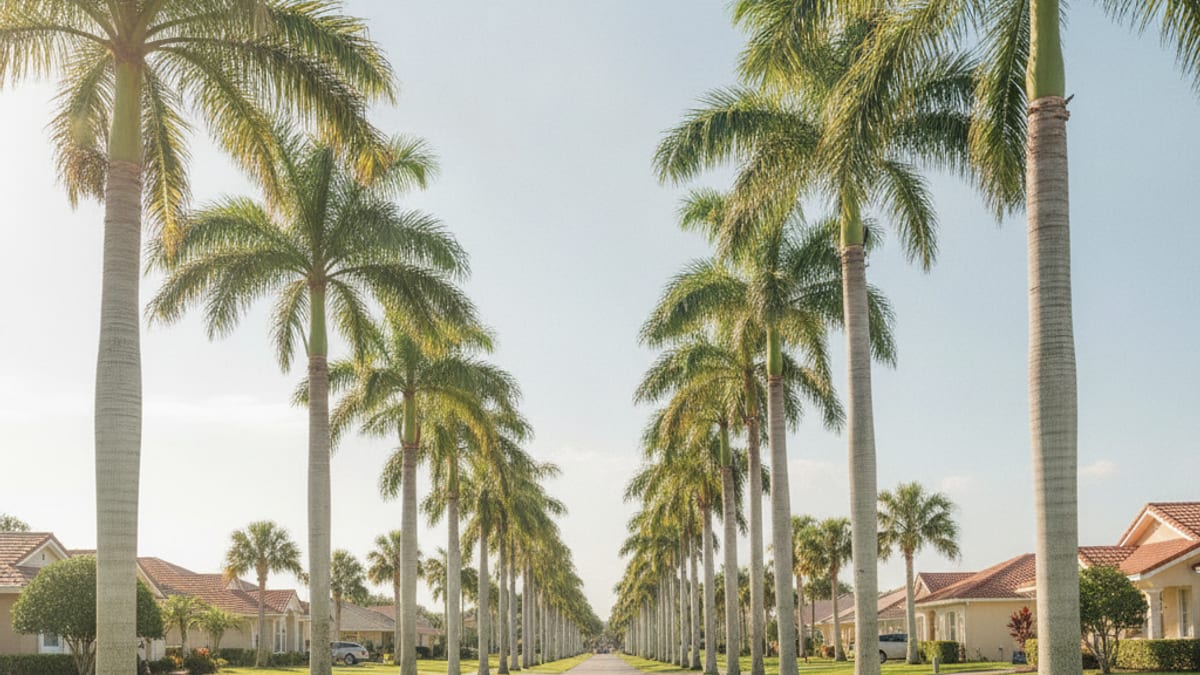
Florida’s state tree grows in nearly every Tampa Bay yard, but the sabal palm and the queen palm that so often sit next to it are not the same tree, and they don’t want the same care. Homeowners tend to treat every palm on the property the same way, one fertilizer schedule, one trimming routine, one watering plan, and that’s usually where problems start. Here’s what each tree actually needs, and where the two diverge.
Sabal palms: tough, but not invincible
The sabal palm, Florida’s official state tree, is about as low-maintenance as a palm gets once established. It tolerates drought, salt exposure, and Tampa Bay’s sandy, fast-draining soil better than almost anything else you’d plant in a yard. That reputation for toughness leads a lot of homeowners to assume it needs no attention at all, which isn’t quite true.
Sabals are slow growers, and that’s normal, not a sign of trouble. What actually signals a problem is a canopy that’s thinning faster than expected, new fronds emerging noticeably smaller than the ones before them, or yellowing that starts at the frond tips and moves inward rather than the natural bottom-up browning of aging fronds. That specific pattern, discoloration that doesn’t follow the normal aging sequence, is one of the early indicators of lethal bronzing, a phytoplasma disease that has affected sabal palms across Florida and has no cure once a tree is infected.
Established sabals rarely need supplemental watering except during extended drought, and they’re sensitive to over-fertilization more than under-fertilization. A slow-release palm-specific fertilizer applied a couple of times a year is usually plenty. Frequent lawn fertilizer applications near sabals can actually cause nutrient imbalances, since standard turf fertilizer doesn’t contain the magnesium and manganese ratios palms specifically need.
Queen palms: faster growing, more demanding
Queen palms grow noticeably faster than sabals and have a fuller, more feathery canopy that a lot of homeowners prefer for the look, but that faster growth comes with higher nutrient needs. Queen palms are prone to manganese and potassium deficiencies in Florida’s sandy soil, and the symptoms show up differently depending on which nutrient is short.
A manganese deficiency shows up as new fronds emerging yellow, stunted, or with a frizzled, scorched-looking appearance, sometimes called “frizzle top.” Left uncorrected, it can eventually kill the growing bud. Potassium deficiency looks different: older fronds develop yellow or orange spotting and necrotic tips while newer growth still looks fine, since the palm pulls potassium from older fronds to support new growth when there isn’t enough in the soil.
Both deficiencies are common enough in Tampa Bay queen palms that a regular palm-specific fertilizer program, applied three to four times a year rather than the one or two applications a sabal needs, makes a real difference in how the tree holds up over time. Queen palms also tend to need more consistent watering than sabals, especially young trees still establishing a root system.
The trimming difference that matters most
Both species share the same core trimming rule: don’t cut fronds that still have green in them, and don’t do a hurricane cut that strips the canopy down to a handful of upright fronds. But queen palms, because they grow faster and produce more fronds per year, can tolerate slightly more frequent trimming than sabals without the same nutrient stress. Even so, one to two trims a year covers what either tree actually needs. For the full reasoning on why over-trimming causes lasting harm to Florida palms, see our guide on how often to trim palms in Florida.
Queen palms also drop large seed pods and a heavier volume of frond litter than sabals, which is often the real reason homeowners feel like they need more frequent trims. Cleaning up seed pods and fully dead fronds doesn’t require touching anything green, so that maintenance can happen more often than an actual pruning cut without hurting the tree.
Cold sensitivity: where the two species really split
This is where sabal and queen palms diverge the most. Sabal palms are remarkably cold hardy for a palm species and handle the occasional Tampa Bay cold snap without much trouble. Queen palms are considerably more cold sensitive, and a hard freeze can cause visible frond damage or, in severe cases, bud injury that threatens the whole tree.
If a freeze warning comes through for Hillsborough or Pinellas county, queen palms are the ones that benefit from protective measures, wrapping the crown or bringing potted specimens indoors if that’s an option. Sabals generally don’t need that same level of protection.
Storm season considerations for both
Neither species should get a “hurricane cut” ahead of storm season, despite how common that request is across Tampa Bay. A properly maintained palm with a full, rounded canopy actually handles high wind better than an over-pruned one, since a fuller canopy of flexible fronds is exactly what palms evolved to do in tropical storm conditions. What actually reduces storm risk is removing dead fronds and loose seed pods that could become wind-driven debris, which is routine maintenance rather than aggressive pruning.
If you’re not sure whether a tree needs storm-specific attention beyond normal care, a storm prep evaluation ahead of hurricane season can flag any structural issues, loose fronds, or lean concerns worth addressing before wind speeds pick up, rather than guessing at what’s safe to leave alone.
Root systems and what’s safe to plant nearby
Both sabal and queen palms have relatively fibrous, non-invasive root systems compared to hardwood trees, which makes them reasonably safe to plant near hardscape and foundations. That said, roots still compete for water and nutrients with anything planted directly underneath the canopy, and dense understory planting right against the trunk can trap moisture against the base in a way that encourages fungal issues over time. Leaving a few feet of clearance around the trunk, mulched rather than densely planted, gives both species better airflow and reduces disease risk.
Watering: less than you’d think, once established
Newly planted sabal and queen palms need consistent watering for the first several months while the root system establishes, typically two to three times a week depending on rainfall. Once established, usually within the first year for queen palms and somewhat longer for sabals, both species handle Tampa Bay’s natural rainfall patterns reasonably well without supplemental irrigation, except during extended dry stretches in spring before the wet season arrives.
Overwatering established palms, particularly sabals, can actually cause more problems than underwatering, since consistently soggy soil around the root zone creates conditions favorable to root rot and other fungal issues. If your irrigation system is set to run daily regardless of rainfall, that’s worth reconsidering for palms specifically, even if the rest of your landscaping is on the same zone. A separate zone or manual watering schedule for palm areas gives you more control over avoiding the overwatering problem entirely.
Common mistakes Tampa Bay homeowners make with both species
Mulching too close to the trunk is one of the most common issues, since piling mulch directly against the base traps moisture against the trunk and can encourage rot at exactly the point where the tree is most vulnerable. Keep mulch pulled back a few inches from the trunk itself, even though it’s tempting to build it up right against the base for a cleaner look.
Using standard lawn fertilizer as the primary nutrition source for palms is another frequent mistake, since turf fertilizer isn’t formulated for the magnesium, manganese, and potassium ratios palms specifically need, and can worsen the deficiency patterns described above rather than solving them. A palm-specific slow-release fertilizer, applied on the schedule appropriate to the species, addresses this directly.
Finally, treating every palm on the property identically, same fertilizer schedule, same trim frequency, same watering plan, regardless of species, age, or visible condition, is the root cause of a lot of avoidable palm health problems across Tampa Bay yards. A young queen palm establishing its root system and a mature sabal that’s been in the ground for decades have genuinely different needs, even standing a few feet apart in the same bed.
When to bring in a professional
Most sabal and queen palm care is straightforward enough for homeowners to manage: occasional fertilizing, watching for the discoloration patterns described above, and resisting the urge to over-trim. Where it’s worth calling in help is anything involving working at height near power lines, suspected lethal bronzing or fungal disease that needs confirmation, or a palm that’s showing bud damage after a freeze or storm, since bud injury can be fatal to the tree if handled incorrectly.
A crew with real palm-tree-service experience will know the difference between a sabal’s normal slow growth and an early lethal bronzing pattern, and between a queen palm’s nutrient deficiency and something more serious. That distinction matters, because the right response to each situation is different, and guessing wrong can cost you the tree.