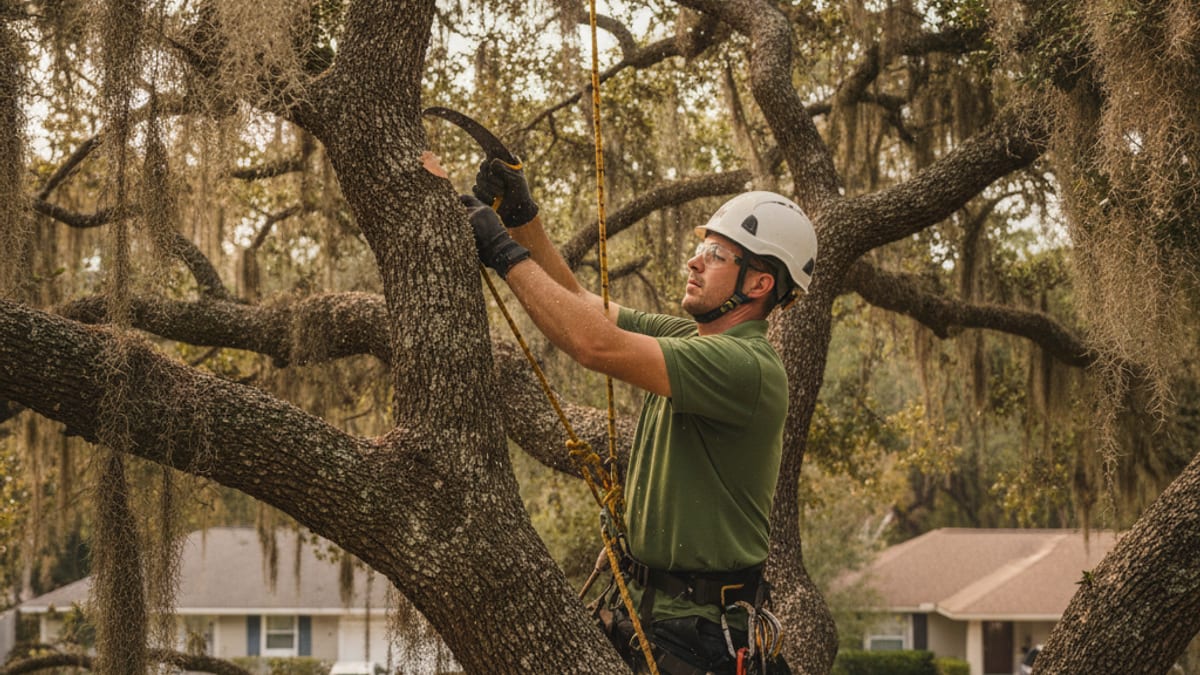
Angi’s Tampa page puts the average tree trimming cost here at about $464, with most projects landing between $272 and $1,816. That’s a wide window for one metro, and the reason isn’t regional pricing games. It’s that “trimming” covers everything from clearing a few limbs off a roofline to a full structural pruning on a hundred-year-old live oak, and Tampa adds a permit step to the big ones that most cost guides never mention.
Here’s what the published numbers actually say, and what moves your quote inside them.
What does tree trimming cost in Tampa Bay?
Published cost guides put most tree trimming jobs somewhere between a few hundred and roughly two thousand dollars. Where your tree lands depends on its size, its condition, and how much work the crew is actually being asked to do.
Angi reports that Tampa homeowners spend about $464 on tree trimming, with the bulk of projects falling between $272 and $1,816. LawnStarter’s 2026 guide is close on the middle, reporting an average of $430 to $640 per tree, though its full published spread runs from about $78 for something small up to $1,835 for a big one. Thumbtack’s national numbers sit a little higher: a $730 average with a typical band of $436 to $1,221.
Those are third-party cost guides, not our prices and not a promise from any crew. The number that matters is the written quote for your tree, on your lot.
LawnStarter also splits its published ranges by tree height, which is the fastest way to sanity-check a bid:
- Under 30 feet, like a young crepe myrtle or a small ornamental: $85 to $415
- Thirty to 60 feet, which covers most mature water oaks and laurel oaks in older neighborhoods: $215 to $790
- Over 60 feet, the mature live oaks and pines: $475 to $1,835
Height gets you in the ballpark, but it isn’t the whole story. A 25-foot tree wedged between a pool cage and a fence can take longer than a 50-foot tree standing alone in an open back yard. Before you approve any tree trimming work, get the scope in writing.
Why do trimming quotes for the same tree vary so much?
Most of the time the quotes vary because the crews aren’t pricing the same job. One bid covers pulling deadwood off the limbs over your roof. The next covers thinning and shaping the whole crown. Same tree, genuinely different work.
Ask each crew to describe the cuts in writing, and to say why. A good scope names which limbs are coming off and what that’s meant to accomplish, whether that’s roof clearance, storm resistance, or correcting a bad branch union.
Access moves the number more than homeowners expect. Fences, pool cages, screened lanais, power lines, and narrow South Tampa side yards all decide whether a crew works from a bucket truck or climbs and rigs every piece down by rope. Climbing and rigging takes longer, so it costs more.
Condition matters too. Selective structural pruning means deliberate cuts throughout the canopy to fix how the tree is built. A quick exterior shape-up is a different service at a different price, and the two shouldn’t be compared as if they’re the same thing.
If the real problem is that the tree is failing rather than overgrown, trimming won’t fix it. Our Tampa Bay tree removal cost guide covers that side of the math.
How much does it cost to trim a palm tree in Tampa?
LawnStarter’s 2026 guide puts palm trimming at $100 to $1,330 per tree. Height and access drive most of that spread, since a sabal you can reach from a ladder and a 40-foot queen palm needing a lift are not the same job.
With palms, though, the cheapest quote is often the one to walk away from, and that’s worth understanding before you pick a bid.
UF/IFAS guidance is to remove only fully brown fronds. The absolute limit is to take nothing that sits above the 9 o’clock and 3 o’clock positions on the crown, and that’s the limit, not the target. A “hurricane cut,” sometimes called pineapple pruning, strips green fronds well above that line. UF/IFAS research indicates it doesn’t meaningfully reduce wind resistance, and that it weakens the palm and leaves it more vulnerable to storm damage.
The reason is simple. Palms feed themselves through their fronds. Strip the green and you’ve taken away the tree’s food supply going into the season it needs to recover from. So a crew offering a flat cheap price to hurricane cut a row of queen palms is selling you damage at a discount.
Ask what’s coming off before you agree to anything. Our palm tree service page covers how the crews in our network approach it, and we’ve written separately on how often Florida palms actually need trimming.
Does the City of Tampa require a permit to trim a tree?
Inside City of Tampa limits, yes, on larger trees. There’s no permit required to prune a tree measuring 23 inches DBH or under. At 24 inches DBH or greater, you need a pruning permit before the work starts. DBH is trunk diameter measured at breast height, and on a mature live oak it’s easy to cross that line without realizing it.
The permit gets inspected by a Forester from Natural Resources before it’s released. A City of Tampa Self-Certified Private Arborist can perform that inspection instead and submit a report for Natural Resources to review, which is usually the faster path. The city also requires pruning to follow ISA and ANSI standards, so this isn’t a paperwork formality: it constrains how the tree gets cut.
A Grand Tree in Tampa is 32 inches DBH or greater. If your oak is in that range, treat the scope and the paperwork as part of the job rather than an afterthought.
These thresholds are the City of Tampa’s. Unincorporated Hillsborough County, the Pinellas municipalities, and Pasco County each set their own, so two nearly identical oaks a few miles apart can carry different requirements. Your address decides which rules apply, which trips up plenty of homeowners near a city boundary. Our Tampa tree permit guide walks through the jurisdiction question in more detail.
One practical note: if a crew tells you a 30-inch oak inside city limits needs no paperwork at all, that’s a reason to keep calling. An arborist consultation will tell you where your tree actually stands before you start comparing bids.
How much of a tree can be trimmed at once?
Standard arboricultural practice is to take no more than roughly 25 percent of a tree’s live canopy in a single growing season. That’s a widely used guideline, not a City of Tampa code number, and for a stressed or older tree the right answer is usually well under it.
Species, condition, structure, and the goal all shape how much should come off. Removing more doesn’t produce a better tree, and on a mature oak it can set the tree back for years.
Ask the arborist to explain the canopy goal in plain language. If nobody can tell you why a specific limb is coming off, that limb probably shouldn’t be.
When does trimming cost more than it should?
Trimming costs more than it should when the scope doesn’t match the tree. A broad proposal that includes cuts nobody can justify is money spent on damage. A vague proposal that never defines cleanup or permit responsibility is a change order waiting to happen.
Price also gets misleading when the bids describe different outcomes. One crew prices selective pruning through the canopy. Another prices the visible branches near the house. The second number is lower because it’s less work, not because it’s a better deal.
Palm quotes deserve the most scrutiny. An aggressive hurricane cut looks like more work for less money, and it’s the one case where paying more for less cutting is the right call.
How often does a Tampa Bay tree need trimming?
There’s no fixed schedule that fits every tree in Tampa Bay. Condition and surroundings set the timing, not the calendar.
Branch structure, clearance needs, how the tree was cut last time, and its current health all factor in. Palms should be judged on frond condition, not on a cosmetic schedule or on what the neighbors did.
Skip cuts the tree doesn’t need. An arborist can tell you whether your tree needs corrective work now, clearance before storm season, or just another look in a year.
What does emergency or after-hours trimming cost?
Thumbtack reports that tree trimmers commonly charge $60 to $80 per hour, and that emergency or after-hours work can reach $250 per hour. Those are published national figures, not rates set by Tampa Tree Pro, but the shape holds locally: urgent work costs more because it interrupts everything else.
When a limb comes down at 2 a.m., keep the urgent scope narrow. Deal with the immediate hazard, then handle the rest of the tree on a normal schedule when you can compare quotes properly. Bundling both into one after-hours bill is how a $400 job becomes a $1,400 one.
Tampa Tree Pro is available 24/7 across the Tampa Bay service area, and our emergency tree service connects you with insured crews when the timing isn’t yours to choose. Trees along mature streets in South Tampa and the older neighborhoods tend to generate the most of these calls, since the canopy there sits directly over the rooflines.
How do you compare tree trimming quotes that don’t match?
Compare the written scopes first, then the totals. Every proposal should name the tree, the intended cuts, the cleanup, the timing, and who handles any permit.
Run each bid through this list:
- Confirm every crew priced the same trees, not a different count
- Ask which limbs or canopy areas are being addressed, and why
- Separate structural pruning from basic clearance work
- Check whether debris haul-away is included or extra
- Identify who pulls the permit if the tree is 24 inches DBH or more
- Ask whether an ISA-certified arborist reviewed the plan
- Turn down any palm scope built around a hurricane cut
- Get clarification on every vague allowance or exclusion
Once the scopes match, the lowest bid is often the right one. The problem was never that cheap quotes are bad. It’s that unmatched quotes aren’t comparable.
Getting a real number for your tree
Tampa Tree Pro connects Tampa Bay homeowners with licensed, insured tree crews, including ISA-certified arborists for trees that need a real evaluation before anyone starts cutting. We don’t set the price. The crew that walks your property does, and they put it in writing.
If you’ve got quotes that don’t line up, or a big oak you’re not sure needs a permit, tell us about the tree and we’ll get the right person out to look at it.
Frequently asked questions
What is the average tree trimming cost in Tampa?
Angi reports an average of about $464 for tree trimming in Tampa, with most projects between $272 and $1,816. That’s a third-party estimate rather than a quote, so treat it as a sanity check on the bids you’re already holding.
Is tree height the main factor in a trimming price?
No. Height gets you a rough band, but access, canopy condition, branch placement, scope, and permit requirements can all move the number more than height does. A short tree crowded by a pool cage and a fence can price above a taller tree standing in the open.
Does a large Tampa tree always need a pruning permit?
No, it depends on the address and the trunk measurement. Inside City of Tampa limits, a tree 24 inches DBH or greater needs a pruning permit before work begins. Unincorporated Hillsborough, the Pinellas municipalities, and Pasco set their own thresholds, so call the jurisdiction that covers your property rather than assuming Tampa’s rule applies.
Is a hurricane cut a good way to save money on palms?
No. UF/IFAS research indicates hurricane cutting doesn’t meaningfully reduce wind resistance, and that stripping healthy green fronds weakens the palm against storms. Ask for a scope limited to fully brown fronds, and don’t pick a palm bid because it removes the most growth.
Should trimming and removal appear on the same quote?
They can, but keep them as separate line items. Trimming manages selected limbs or canopy areas; removal takes the whole tree. Splitting them makes the proposal far easier to compare against a competing bid, and it keeps you from paying removal-tier pricing for pruning work.
How does Tampa Tree Pro help with a trimming quote?
We connect you with licensed, insured crews across Tampa Bay, and with ISA-certified arborists when a tree needs a professional evaluation first. The crew that inspects your tree writes the quote. Our job is getting the right one to your property.