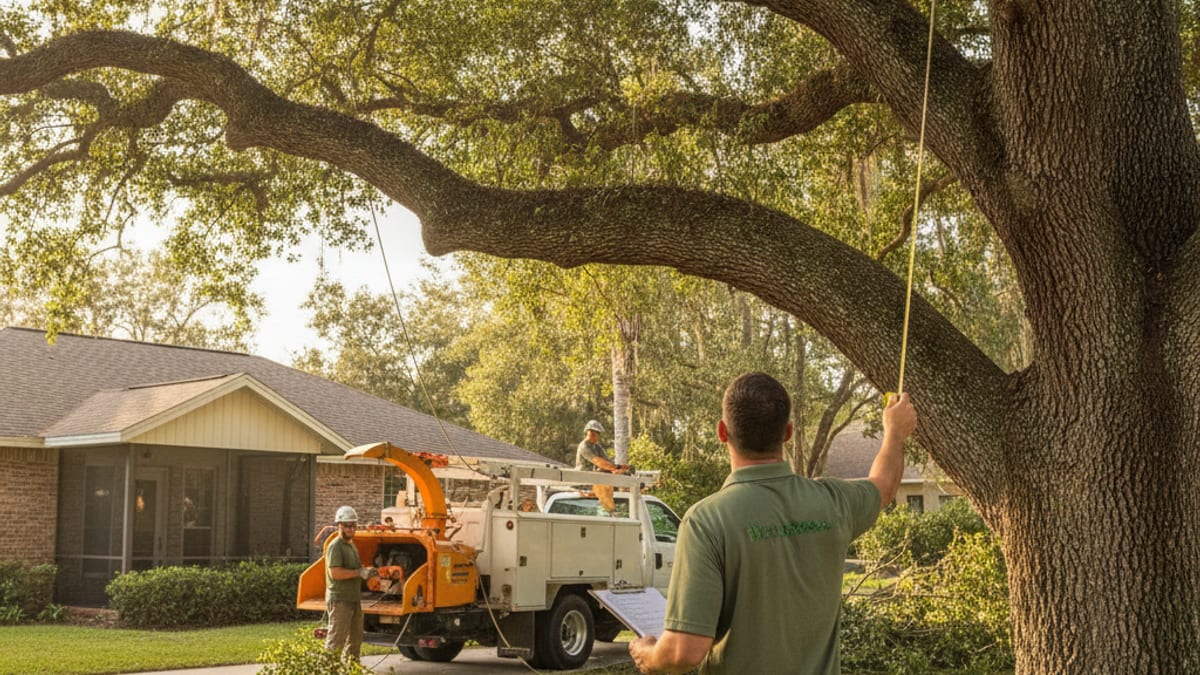
A homeowner in Seminole Heights recently told us she got three tree removal quotes for the same laurel oak and they ranged from $650 to $2,400. That spread is normal in Tampa Bay, and it usually has nothing to do with anyone trying to overcharge her. It comes down to how each crew reads the job: the size of the tree, what it’s standing next to, and how hard it will be to get the wood off the property.
If you’re staring down a dead pine leaning toward the roof or a live oak that’s finally outgrown the yard, knowing what moves the number helps you tell a fair quote from a lowball that turns into change orders once the saws start.
The size and species matter more than anything else
Tree removal pricing in Tampa Bay generally scales with trunk diameter and total height, but not evenly. A 20 foot crepe myrtle and a 20 foot slash pine are not the same job. Pines grow tall and straight with less canopy to manage, which can make them faster to drop in open yards. A sprawling live oak with a 40 foot canopy takes far longer to break down piece by piece, even if its trunk isn’t dramatically taller.
Rough ranges homeowners in the area typically see:
- Small trees under 30 feet (crepe myrtle, young queen palm): $200 to $600
- Medium trees, 30 to 60 feet (water oak, laurel oak, slash pine): $600 to $1,800
- Large trees over 60 feet (mature live oak, longleaf pine, bald cypress): $1,800 to $3,000 or more
- Palms, priced by height rather than trunk width: $200 to $900 depending on species and reach
These are starting points, not promises. A leaning, storm-damaged, or dead tree changes the math because it changes the risk, which we get into below. Get a firm, written quote for your specific tree before you agree to anything.
Access is often the real cost driver
Two identical oaks can cost very different amounts to remove depending on what surrounds them. A tree standing alone in an open Wesley Chapel lot with room for a bucket truck and a chipper is a straightforward job. The same tree wedged between a fence, a pool cage, and a neighbor’s driveway in a tighter Clearwater or St. Petersburg lot means everything has to come down in smaller, more controlled pieces, often by hand or with rigging ropes instead of just letting gravity do the work.
Overhead power lines add another layer. If branches are tangled in service lines, the crew may need to coordinate with the utility company before cutting, which adds time and sometimes a separate scheduling step. Tight side yards, block walls, sheds, and pool enclosures all push a job from a quick drop-and-haul into a slower, more deliberate tree removal that costs more because it has to.
Whether the tree is a hazard changes the math
A tree that’s already leaning, has visible root plate lift, or shows large dead limbs isn’t priced the same as a healthy tree someone simply wants gone for landscaping reasons. Hazardous removals often require the crew to work in sections, secure loads with rigging, and sometimes bring in a crane rather than free-felling the tree, especially when the lean points toward a structure.
This is where crane-assisted removal comes in. It looks expensive on paper compared to a straightforward cut-and-drop job, but for a tree that’s too risky to fell conventionally, near power lines, or hanging over a roofline, it’s often the safer and ultimately cheaper option once you account for what a mistake could cost in property damage.
Stump removal is a separate line item
Most removal quotes cover cutting the tree down and hauling the wood away, but the stump usually costs extra unless you specifically ask for it to be included. Stump grinding typically runs by the diameter of the stump, often somewhere in the $75 to $400 range for a single tree, though large oak stumps with wide root flares can run higher. If you’re planning to replant in that spot, plant grass, or pour a patio, factor the grinding into your total budget up front rather than being surprised by it later.
Do you actually need the stump gone
Not always. A ground-level stump tucked in a back corner that nobody will trip on or mow around can sometimes just be left to decompose. But a stump in a front yard, near a driveway, or in a spot you plan to landscape is worth grinding while the crew is already on site, since a separate trip later usually costs more than adding it to the original job.
Emergency and after-hours work costs more
A tree that’s already down across a driveway after a storm, or one that’s cracked and hanging over a car, isn’t priced like a scheduled removal. Emergency work means a crew reshuffling their day or coming out after hours, and that urgency shows up in the invoice. If a tree is actively threatening a structure, a person, or a power line, emergency tree service is worth the premium. If it’s simply inconvenient but stable, scheduling it as a normal job will save you money.
Permits can add time, if not always dollars
Depending on where the tree sits in Hillsborough, Pinellas, or Pasco county, and whether it’s a protected species like a mature live oak, removal may require a permit from the city or county before work begins. This doesn’t necessarily add a huge cost, but it can add time, since some jurisdictions require documentation from a certified arborist showing the tree is dead, diseased, or hazardous before they’ll sign off. Ask whoever quotes the job whether your tree is likely to need one. We cover the specifics in our guide to tree removal permits in Tampa.
Multiple trees or a cleared lot cost less per tree
If you’re removing one tree, you’re paying for a full mobilization: equipment on a trailer, a crew driving out, setup, and cleanup, all for a single trunk. If you’re clearing several trees at once, whether it’s three declining laurel oaks along a fence line in Land O’ Lakes or a wooded back lot you’re prepping for a shed or pool, the per-tree cost usually drops because the crew is already on site and the equipment is already staged. For a larger job, like clearing a wooded parcel before construction, land clearing is typically priced by the acre or by the day rather than tree by tree, which can work out considerably cheaper than removing the same number of trees individually over several visits.
If you know you’ll eventually want two or three trees gone, it’s worth asking whether bundling them into one visit changes the price, rather than calling separately as each one becomes a problem.
Commercial properties price differently
A homeowner calling about a backyard oak and a property manager calling about a row of declining trees along a shopping plaza parking lot are not the same job, even if the trees themselves are similar. Commercial tree service work often involves coordinating around business hours, protecting parked cars and storefronts, meeting HOA or municipal landscaping requirements, and sometimes working around tenants or customers during the job. That added coordination, plus often larger scope, typically means commercial quotes are built differently than a single residential removal, with more detail around scheduling, traffic control, and liability. If you manage a commercial property in Tampa Bay, it’s worth asking for a site walk rather than a phone estimate, since parking lot access and liability requirements vary a lot from property to property.
What DIY removal actually risks
It’s tempting to look at a mid-size tree and think a rented chainsaw and a free Saturday could save a few hundred dollars. For a small, isolated tree with no structures nearby, that math can work out. For anything with real height, anything near a fence, roofline, or power line, or anything already leaning or storm-damaged, the risk profile changes fast. Falling limbs and trunk sections carry enormous force, chainsaw injuries are common even among experienced users, and a miscalculated fell direction can turn a tree removal into a new roof or a trip to the hospital. The money saved on a DIY job rarely covers what a mistake costs, and it’s part of why professional crews carry liability insurance in the first place.
How to compare quotes that don’t match
When quotes come back wildly different, the gap is usually explained by one of a few things: whether stump grinding is included, whether the crew is factoring in difficult access, whether they’re planning to use a crane versus free-felling, and whether hauling and cleanup are part of the price or billed separately. Ask each company to break down what’s included in writing.
It’s also worth confirming insurance before you sign anything. A tree removal crew working near your house, your neighbor’s fence, or overhead lines should carry liability coverage and workers’ compensation. Ask to see proof of both, and don’t be shy about it. A legitimate crew expects the question.
If you’re not sure whether a tree needs to come down at all, it’s worth a second look before you commit to removal. Our guide on when to remove versus save a tree walks through the signs that tip the decision one way or the other.
Getting an accurate quote
The fastest way to get a number you can trust is to have someone look at the actual tree rather than describe it over the phone. Send photos from a few angles, including anything the tree is near, like power lines, fences, or the house itself. From there, we can connect you with an insured local crew that serves your part of Hillsborough, Pinellas, or Pasco county for a firm, on-site quote before any work starts.